Toe-Kick Drawers & Toe-Kick Lighting: Hidden Kitchen Storage Upgrades
You can spend a lot on a new kitchen and still live with the same daily annoyances: crowded drawers, pans that never quite fit, a dark path to the fridge at night, kids rummaging under dim cabinets.
The strip of space at the bottom of your cabinets, the toe-kick, usually does nothing to help. It’s there for an important reason, but much of its potential often goes unexplored.
Toe-kick drawers and toe-kick lighting offer two ways to make better use of that space: hidden storage space and soft floor-level illumination for easier nighttime navigation.
If you’re planning a remodel or new build, these small details can do wonders for improving how your kitchen feels and functions every day.
In this guide, you’ll see how toe-kick drawers and lighting work, what they’re really good for, the trade-offs to watch for, and a simple way to decide if they belong in your next kitchen project.
What Are Toe-Kick Drawers?
The toe-kick itself is the recessed section beneath kitchen cabinets, typically around 4 inches high and 3 inches deep, although these dimensions can vary. This design allows you to stand closer to the countertop, reducing back strain and enhancing ergonomics.
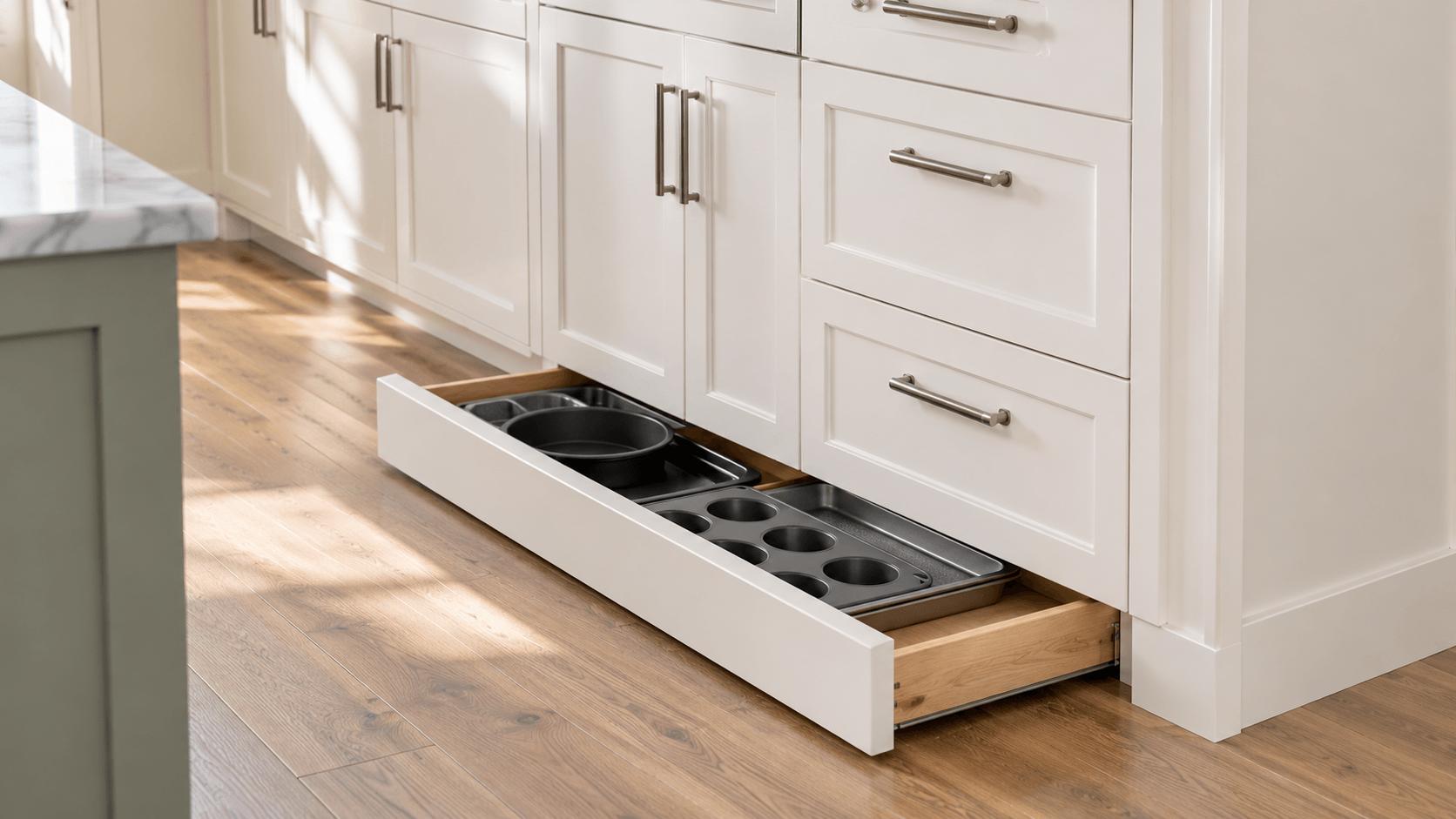
Toe-kick drawers are a clever design solution that transforms this often-overlooked space beneath base cabinets into practical storage space.
Designed to fit within the toe-kick, these hidden drawer storage options provide out-of-sight storage for slim, lightweight items, maximizing kitchen storage without encroaching on conventional cabinet space.
In a toe-kick drawer system, the toe-kick panel becomes the drawer front, seamlessly integrating a low-profile drawer box that slides out effortlessly when needed. When closed, these drawers blend into the cabinetry, offering a clean, uninterrupted aesthetic appeal that complements any kitchen style.
Whether used for storing baking tools, cleaning supplies, pet supplies, or even folding step stools, toe-kick drawers offer a practical storage solution that can also be adapted for custom cabinetry in other areas, like bathroom vanities, enhancing your home's overall functionality and storage capacity.
How Do Toe-Kick Drawers Work?
In a typical cabinet, the toe-kick sits either on a separate ladder-style base or as part of cabinet sides that run all the way to the floor.
Separate bases may offer more flexibility for incorporating drawer units, depending on their support structure. Integrated sides often mean toe-kick drawers need to be designed in from the start rather than added later.
Because the vertical space is limited, these drawers are best for light, flat items, and for things you don’t mind bending to reach, such as:
- Baking sheets, pizza stones, and cooling racks
- Cutting boards and placemats
- Spare trays, lightweight grill accessories, or pet leashes
Heavy pans, stacks of dishes, or bottles are usually a bad fit. You’re working within the load limits of compact hardware sitting closer to the floor, where it sees more bumps from feet, vacuums, and mops.
Keep in mind that the usable interior height of a toe-kick drawer is smaller than the height of the toe-kick itself. The drawer box, slides, and installation clearances all take up room.
That makes checking actual dimensions especially important before deciding what to store.
What to Consider When Installing Toe-Kick Drawers
- Hardware: Push-to-open mechanisms maintain a clean, seamless appearance but may open accidentally when bumped. Discreet pulls are easier to operate, although they remain visible and must be positioned to preserve comfortable toe clearance.
- They're an early decision: If you're planning new cabinetry, discuss toe-kick drawers early in the design process. Building them into suitable cabinet bases from the start is generally easier than retrofitting existing cabinets.
- Base must be reinforced: Installation involves more than adding a shallow drawer. The cabinet base must retain its structural support, while the drawer box, slides, and front need to fit without compromising foot clearance or required airflow.
- Utilities can get in the way: Plumbing, appliance vents, and maintenance access can further limit where drawers belong.
Cabinet specialists like Cabinet IQ can assess these constraints and determine whether the design is practical before installation begins.
Toe-Kick Drawers Pros and Cons
Toe-kick drawers are most valuable when they quietly solve specific problems instead of trying to act like your main storage. Think of them as helpers, not heroes.
They shine when they rescue you from clutter without becoming everyday, high-traffic drawers.
Toe-Kick Drawers Benefits
The biggest advantage is reclaiming overlooked space without sacrificing more accessible storage. In smaller kitchens where every inch counts, moving slim, occasional-use items into toe-kick drawers frees up conventional drawers for everyday cookware.
For example, in a compact condo kitchen where cookie sheets and serving trays occupy much of a base drawer, relocating them to appropriately sized toe-kick storage could make room for pots and pans at a more comfortable height.
In family kitchens, one or two drawers could also keep placemats, pet gear, seasonal accessories, or even all those appliance manuals organized without crowding the main cabinets.
Toe-Kick Drawers Drawbacks
The trade-offs are worth considering:
- More mess exposure: floor-level drawers collect crumbs, pet hair, and mop splashes.
- More maintenance concerns: hardware is exposed to bumps and potential water damage from leaks.
- More bending: low placement makes these drawers less convenient for frequently used items.
Toe-kick drawers also offer less capacity than conventional base drawers, so they're better suited to supplemental or even leftover storage than daily use essentials.
Toe-Kick Drawers vs Traditional Cabinet Storage
Not all kitchen storage serves the same purpose.
The best option depends on how often you use an item, how easily you need to reach it, and whether your existing storage is already working efficiently.
| Option | Best For | Main Tradeoff |
| Toe-kick drawers | Slim, flat, rarely used items like baking sheets or emergency supplies | Saves conventional cabinet space but offers limited capacity and accessibility |
| Deep base drawers | Everyday pots, pans, and dishes | Greater capacity and easier access |
| Vertical dividers | Trays, cutting boards, and baking pans | Easy visibility but requires cabinet height |
Toe-kick drawers work best as a complement to traditional cabinet storage, not a replacement.
Before adding toe-kick storage, consider whether better organizers could make your existing cabinets more efficient.
The goal is to give every item a sensible home, not simply add more drawers.
What Is Toe Kick Lighting?
Toe kick lighting is a low-level lighting solution that integrates LED strips or modules into the recessed base of your kitchen cabinets or bathroom vanity.
This kitchen lighting design allows light to wash across the floor, enhancing both the aesthetic appeal and functionality by illuminating pathways or obstacles at night without the need for bright overhead fixtures.
Think of it as a built-in nightlight that follows the path of your cabinetry, creating an elegant and practical under-cabinet lighting solution for those late-night trips to the kitchen or bathroom. This technology typically utilizes energy-efficient LED lighting to offer soft illumination at ankle height, adding both safety and ambiance.
Typically, toe kick lighting involves LED strip lights mounted inside a slim channel or hidden behind a trim piece, so the effect is visible, but the hardware remains out of sight.
By using diffusers, the LED strips create a smoother line of light, which is particularly useful over reflective floors. This kind of custom cabinetry accent lighting not only enhances your space's style but can also improve visibility and reduce the risk of tripping over unseen objects.
Whether part of a kitchen remodeling project or as a standalone enhancement, toe-kick lighting can be the perfect solution for adding both atmosphere and increased functionality to your home.

How to Install Toe-Kick Lighting During a Remodel
In practice, installation is less about the lights themselves and more about planning and coordination. This overview is for planning only; electrical wiring and connections should be handled by appropriately licensed professionals in accordance with applicable codes and product instructions.
Step 1: Plan Your Runs and Controls
Decide which cabinet runs should glow, the power sources, the type of LED products, and whether you want wall switches, motion sensors, dimmers, or compatible smart-home scenes.
Think about how the kitchen is used after dark. A short, well-placed run may be more useful than lighting every cabinet base.
Step 2: Rough-In Wiring and Drivers
During the appropriate stage of the remodel, a licensed electrician plans and installs the necessary wiring and compatible power supplies or drivers.
Driver locations should be accessible for future service, and electrical components must be suitable for their intended environment.
Step 3: Mount Channels and Strips
Once the cabinetry and surrounding finishes are ready, the installer mounts channels and LED strip lighting in the planned locations, keeping them clear of drawers, removable panels, appliance ventilation, and cleaning tools.
Fixture placement should also account for glare and reflections from polished floors.
Step 4: Document for Future Service
Photos of wiring routes, notes on driver locations, and a marked plan turn your lighting from a one-off trick into a maintainable part of the house.
Before the project is finished, test the lighting at night to check brightness, shadows, and reflections.
Imagine a busy family kitchen with motion-activated toe-kick strips along the sink and fridge runs.
The kids could grab water or a snack at night without turning on bright overheads. The fixtures themselves would disappear into the recess, while the illuminated path would feel calmer and easier to navigate.
Because more than one trade is involved, someone needs to own the coordination. In many remodels, the smoothest projects are the ones where the designer or cabinet company leads the planning, looping in the electrician and flooring installer early so no one is surprised by where lights or drivers need to live.
Toe-Kick Lighting Pros and Cons
Toe-kick lighting can be worth it if the kitchen feels calmer and more comfortable.
- A soft perimeter glow can help you see nearby cabinet edges and obstacles without the jolt of full overhead light.
- For older adults or anyone with reduced vision or balance, thoughtfully designed low-level lighting may be a useful supplement to the kitchen’s overall lighting plan.
It should not, however, be treated as a substitute for adequate general illumination or lighting needed to identify hazards throughout the room.
Visually, it can add a quiet luxury note. Cabinets appear to float slightly above the floor.
Wood grains, tile patterns, and rug textures pick up just enough light to feel intentional. In smaller kitchens, that extra depth at the base can make the room feel a bit lighter and less bulky.
Here’s a quick snapshot of the practical trade-offs:
| Focus | What You Gain | What to Watch For |
| Nighttime visibility | Softer illumination along cabinet runs | Low lighting may not reveal every hazard |
| Aesthetics | Floating-cabinet appearance and richer textures | Glossy floors can reflect LED dots |
| Cost | Efficient LED operation | Electrical work and installation costs |
| Longevity | Potentially long LED service life | Inaccessible drivers complicate replacement |
How Much Does Toe-Kick Lighting Cost?
The LED products themselves may be a relatively modest part of the budget.
Depending on the project, electrician time, wiring access, controls, channels, and cross-trade coordination can account for a substantial share of the installed cost.
Operating costs are generally modest with efficient LED strip lights, especially at the low brightness levels commonly used for nighttime illumination. Actual energy use depends on the system’s wattage and how long it operates.
Rather than relying on a generic price per linear foot, ask for an estimate based on your cabinet layout, lighting runs, controls, electrical access, and installation requirements.
There are pitfalls worth planning around:
- Bare strips on glossy floors can show dotted reflections instead of the desired ambient glow unless you use suitable diffusers or frosted channels.
- Mismatched color temperatures can make floor lighting look odd next to older under-cabinet or ceiling fixtures.
- Drivers buried behind permanent panels turn simple replacements into invasive, costly work.
- Poorly positioned motion sensors can activate lights unnecessarily or fail to respond where you need them.
When you treat toe-kick lighting as one layer in a broader lighting plan, after you’ve already solved general and task lighting, it finishes the room instead of compensating for bigger gaps.
A cabinet specialist or design team, such as Cabinet IQ, can help you consider how that lighting fits into a coordinated kitchen remodel so the effect feels intentional rather than gimmicky.

When Are Toe-Kick Drawers and Lighting Worth It?
Toe-kick upgrades are worth considering when they solve a specific problem without compromising your kitchen's functionality.
Not every kitchen needs these features, and if your existing storage is sufficient, your lighting already works well, or your remodeling budget is stretched, improving the main cabinet layout, pantry organization, or task lighting may offer greater value.
Plan Your Toe-Kick as a Floorline System
The cleanest projects treat the toe-kick as a coordinated part of the kitchen rather than a place to add clever features one by one.
Start by looking at each cabinet run and deciding whether it should accommodate storage, lighting, both, or neither.
Then consider three practical questions:
- Where would storage help most? Identify uninterrupted cabinet runs where shallow drawers could free up more accessible storage elsewhere.
- Where would lighting be useful? Focus on areas where soft floor-level illumination would improve nighttime comfort or complement the kitchen's appearance.
- What needs to remain accessible? Account for cabinet supports, plumbing, appliance ventilation, electrical components, and maintenance access before finalizing the design.
These decisions should inform cabinet elevations, electrical plans, and flooring details early in the remodel.
For example, a planned drawer might conflict with a vent, or a lighting driver might need an accessible location that wasn't included in the original cabinetry plan.
A cabinet specialist or kitchen design team such as Cabinet IQ can help evaluate these details alongside your overall kitchen layout, ensuring that toe-kick upgrades support the design rather than complicate it.
Can Toe-Kick Drawers and Toe-Kick Lighting Work Together?
Yes, toe-kick drawers and toe-kick lighting can work together in the same kitchen, but combining them within the same cabinet run requires careful planning.
- Space for both is needed: A drawer needs clearance to open and close, while lighting requires a protected mounting location and a suitable path for wiring. Cabinet supports, ventilation, toe clearance, and maintenance access must also be considered before the layout is finalized.
- Alternating as a potential solution: In some kitchens, compatible cabinet and lighting systems may allow both features to share a run without interfering with drawer movement or foot clearance, but in others, the simplest solution might be to install drawers beneath one uninterrupted cabinet run and lighting beneath another.
- Consistency matters when combining: Compatible drawer dimensions, a uniform recess depth, coordinated lighting color, and thoughtfully placed controls help the floorline look intentional rather than pieced together.
- Detailing for future repairs and cleaning: Durable finishes, removable access panels where needed, and accessible electrical components make it easier to mop, vacuum, and maintain the system without unnecessary disruption.
The important thing is not to assume that a lighting strip can be added anywhere a toe-kick drawer is installed—or vice versa. Both features need to be coordinated with the cabinet's construction from the beginning.
The goal is a coordinated feature that works reliably and not simply fitting both upgrades into every available space.
Make Every Inch Count With Cabinet IQ
The best kitchen upgrades aren't always the most noticeable. Sometimes, they're the hidden details that make everyday life easier, like toe-kick drawers that keep clutter out of sight or soft lighting that makes nighttime trips to the fridge more comfortable.
Whether you're interested in toe-kick storage, toe-kick lighting, or both, the key is to plan these features alongside your cabinetry, layout, and overall kitchen design.
At Cabinet IQ, we believe a beautiful kitchen should work just as well as it looks.
Our team helps you uncover overlooked storage opportunities, explore practical cabinet upgrades, and coordinate design details that make your kitchen more functional. From a personalized initial consultation to precise measurements and detailed 3D renderings during the design process, we help you see how thoughtful improvements fit into your bigger remodeling vision before installation begins.
Ready to make every inch of your kitchen count? Schedule your free consultation with Cabinet IQ, and let's bring smarter design to life.