
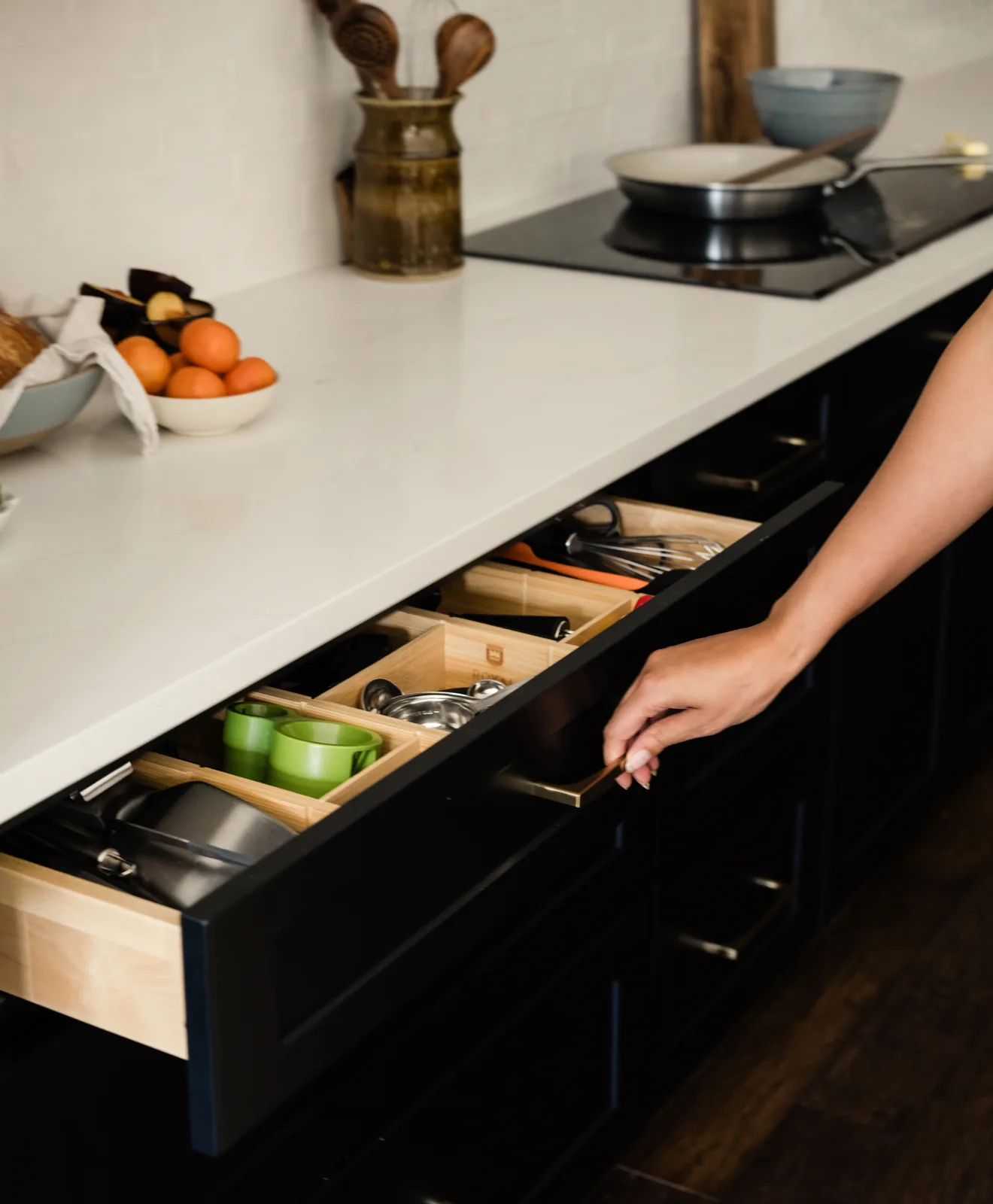
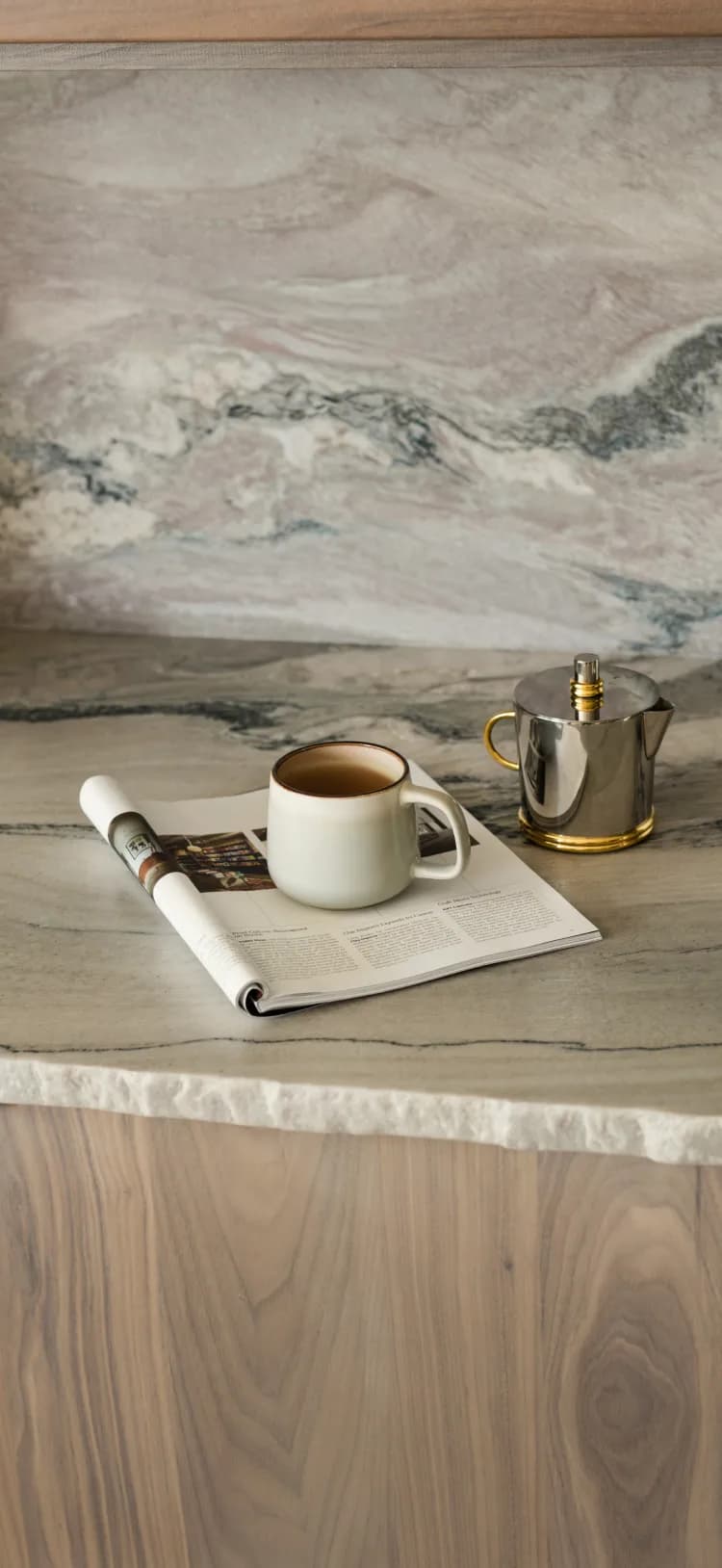




Granite slabs are one of a kind. Where each piece comes from on the slab is part of the install plan. The veins near a seam get matched before cutting starts. Granite also gets sealed, and your installer can tell you how absorbent your particular stone is.

Countertop Installation in Pittsburgh, PA
The step that gives you your kitchen back
Countertop installation in Pittsburgh is the step that turns a room of new cabinets back into a working kitchen. It runs in three parts: templating, fabrication and install day. Each part depends on the one before it.
Stone and quartz have no give. A counter that is a quarter inch off can't be pushed into place like a cabinet door. That's why counters are measured from cabinets already fixed to the wall, never from a drawing.
Cabinet IQ of North Pittsburgh sends the installers who hang your cabinets back to template the counters. We cut and finish the stone in house, then the same crew sets it. Kitchen and bath counters follow that path, and the Perry Highway showroom in Wexford is still being readied.
Installation for each material & cabinet
Every install follows the same order, but the material changes what matters on the day. So do the cabinets underneath.
Quartz is lighter on surprises because its pattern is predictable across the slab. Seams in solid colors almost disappear, while bold veined designs need careful layout. No sealing is needed once it's in.
The counter can only be as level as the boxes under it. Custom and semi-custom cabinets are shimmed, leveled and fixed before anyone measures for stone. A wobbly sink base found on template day pushes the whole schedule back.
Templating, fabrication & install day, in order
Here is what happens at each stage, and what you can do to keep it moving. Most delays start with something that could have been settled a week earlier.
Template day only works if every piece that touches the counter is decided. Have the exact model numbers for your sink, faucet and cooktop or range. The spec sheets give the cutout sizes your counters will be cut around.
Count the holes you want behind the sink, too. A faucet, a soap dispenser and a filtered water tap each need their own. Adding a hole after the stone is cut is possible but rarely looks as clean.
An installer measures every run on site, with the cabinets set and level. You'll confirm the overhang at any seating, where seams fall and how far the sink sits from the window. It helps to be home for this visit.
Older Pittsburgh kitchens bring their own quirks. Plaster walls can bow between studs, and a window sill may sit lower than a standard backsplash. The template records the room as it really is. The finished edge then follows the wall's true shape, with no wide caulk line.
Your template is laid over the slab before any cutting starts. That's when the team decides which part of the stone lands on the island and where veins cross a seam. Then the pieces are cut, the sink and cooktop cutouts are made and the edges are profiled and polished.
Treat the template as final once fabrication begins. Swapping the sink model or moving the range now usually means cutting fresh stone.
The crew carries each section in on edge, sets it down on the cabinets, then brings it level. Seams are joined and smoothed, and an undermount sink is fixed to the underside of the stone. Most of the work is lifting and fitting, not cutting.
Getting heavy pieces into a Pittsburgh house is half the job. Mention steep front steps, a narrow side yard or a tight turn at the stairs at template day. In winter, clear snow and ice from the path the night before, because the crew walks it many times.
Before the crew leaves, walk the kitchen together. Run your palm across each seam and sight along the front edge for a dip. Then check the gap around the sink rim. These are the easiest fixes to make while everyone is still in the room.
What can move your install date
There's no single timeline, because every step waits on the one before it. The usual reasons a date shifts are below:
| What changes | Why it matters |
|---|---|
| Cabinets not fully set | Templating can't start until every base cabinet is fixed and level. |
| Appliance choices still open | Openings are cut to exact models, so an undecided range or sink holds up the template. |
| A color that isn't in stock | Some slabs ship from the supplier, which adds waiting before fabrication. |
| Changes after templating | A new sink or a moved cooktop can mean cutting that section again. |
| Access to the kitchen | Steep steps, tight stairwells or icy paths can need extra hands or a second trip. |
Lock in your sink and appliance choices before template day, and most of these never come up.
Your first week with new counters
New counters are ready for light use the day they go in. A few habits protect the seams and edges early on. Give the adhesive and silicone time to cure before scrubbing near them.
- Never stand or kneel on the counter to reach upper cabinets or hang a light
- Keep heavy loads off an overhang that has no brackets or legs underneath it
- Let the silicone bead around the sink and backsplash cure before wiping it hard
- Wait for the counters to settle before any backsplash tile goes up
After that first week, the care is the same as for your material. Granite needs a sealer kept up over time, and quartz needs a trivet near the stove.

What's included in your installation
Your countertop installation covers the template visit, cutting and finishing in house and setting the counters on your cabinets. It all comes after your free consultation, where you see the kitchen as a colored 3D rendering. We don't supply sinks, so buy yours before template day.

Still choosing a material?
We install granite and quartz, and each behaves a little differently on install day. Granite brings natural variation and a sealer to keep up. Quartz brings a predictable pattern and no sealing at all.
View kitchen countertopsCountertop installation from Moon Township to Allison Park
Our installers cover the suburbs between Cranberry Township and Upper St. Clair. We fit countertops all over Pittsburgh and in:
Mars, Allison Park, Gibsonia, Cranberry Township, Wexford, Sewickley, Coraopolis & Moon Township, Carnegie, Upper St. Clair, Mt. Lebanon.
Frequently asked questions
Yes. The work happens indoors, so cold weather doesn't affect the stone or the adhesives once inside. The real concern is the path from the truck. Clear and salt it so the crew can carry slabs in safely.
Set up a temporary station with a microwave and a hot plate. Many older Pittsburgh houses have a second kitchen in the basement, which makes an easy stand-in. A folding table works for prep until install day.
With side brackets. Screwing into the underside of granite or quartz isn't possible, so the dishwasher fastens to the cabinets on either side. Mention a built-in dishwasher at template day so the gap is planned.
Very little. The cutting, edging and polishing happen before the stone arrives. On install day, the crew mostly lifts, levels and joins pieces, with only small adjustments made on site.
Yes. A slide-in range sits between the counters with a lip that overlaps them. The gap has to match the model exactly. Have the range on hand or its spec sheet ready at template day.
The material and how much of it you need set most of the price. Each seam, cutout and edge detail adds to it, and so does a hard-to-reach kitchen. Share a sketch of your layout at the consultation for a number that fits your home.