Marble Countertops: Pros, Cons, Cost & Marble vs. Quartz
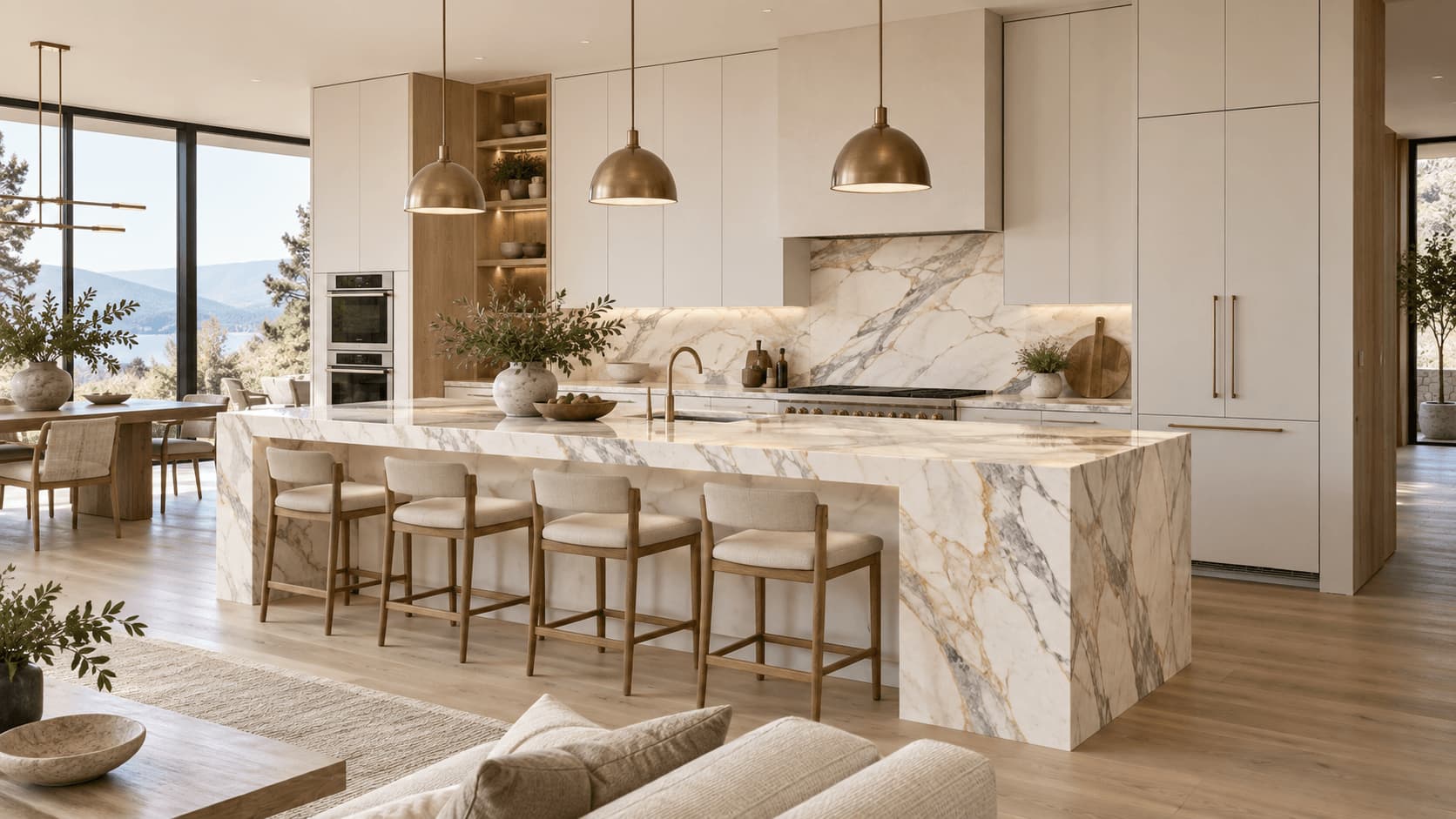
You don’t remodel a kitchen very often. When you do, countertop choices suddenly feel huge. Photos of airy white islands and dramatic natural veining are everywhere and throughout homes, but your real life includes kids, coffee, red wine, takeout containers, and weeknight cooking chaos.
Somewhere between magazine perfection and everyday mess, you’re trying to answer one deceptively simple question: actually, is marble worth it compared to quartz?
Designers and fabricators hear some version of this in almost every design meeting.
Marble is a genuine natural stone, and many of the qualities that make it beautiful also make it different from lower-maintenance countertop materials.
For some homeowners, the trade-offs are absolutely worth it. Natural patterning, distinctive veining, restoration potential, and the way marble develops character over time can make the additional care worthwhile. For others, quartz countertops or another manufactured material can provide a marble-inspired appearance with fewer maintenance concerns.
Use this guide to make an informed decision on marble vs. quartz, based on which surface makes more sense for your kitchen, lifestyle, and budget.
What Is Marble?
Marble is a metamorphic rock that begins its geological life as limestone. When limestone is subjected to heat and pressure beneath the Earth's surface, its mineral structure recrystallizes, creating marble.
That geological process is responsible for much of what makes the material distinctive.
Minerals and impurities within the original stone can contribute to marble's color, movement, and veining patterns. Rather than being printed or intentionally repeated by a manufacturer, those patterns developed naturally as the marble stone formed.
That means every block, and ultimately every slab, has its own characteristics.
This is one of the fundamental differences between marble and manufactured countertop materials such as quartz or porcelain slabs.
Manufacturers can create remarkably convincing marble-look surfaces, but the pattern on genuine marble is the product of geology rather than industrial design.
From Quarry to Countertop
A finished marble kitchen countertop begins as a massive block of stone extracted from a quarry.
Those quarried marble stone blocks are cut into slabs, finished, transported, and eventually distributed through stone suppliers and yards. Once a homeowner selects a slab, a countertop fabricator templates the kitchen and determines how the countertop sections will be cut from the stone.
The process typically involves several stages:
- Selecting the slabs
- Templating the countertop
- Planning seams and vein placement
- Cutting sink, faucet, and cooktop openings
- Fabricating the selected edge profile
- Finishing and polishing exposed areas
- Transporting the finished pieces
- Final installation
The layout stage can be particularly important with strongly veined marble. The same slab can produce dramatically different finished countertops depending on how the fabricator positions the cuts and aligns the veins.
Marble stone's usefulness also extends well beyond kitchen countertops. The material is commonly fabricated into tiles, mosaics, flooring, bathroom surfaces, wall applications, fireplace surrounds, and other architectural features.
Popular Types of Marble for Countertops
"Marble" describes a broad category rather than one uniform appearance.
Individual stones vary in color, mineral composition, veining, background tone, and availability. Even slabs sold under the same marble name can look noticeably different from one another.
Three names homeowners frequently encounter when shopping for white marble are Carrara, Calacatta, and Statuary.
Carrara Marble
Carrara marble is one of the most recognizable varieties used in residential interiors. It is associated with Carrara, Italy, and typically features a white to light-gray background with softer gray veining.
Compared with some of the more dramatic white marbles, Carrara can have a quieter, more understated appearance. That makes it versatile in both traditional and contemporary kitchens.
But don't assume every Carrara slab will look alike. Background color, vein density, movement, and tone can vary considerably from one slab to another.
Calacatta Marble
Calacatta marble is often selected when the goal is a stronger visual contrast.
It is typically associated with a lighter or whiter background and bolder, more dramatic veining than many Carrara slabs. Some Calacatta varieties feature gray movement, while others can incorporate warmer gold or brown tones.
Because the movement can be dramatic, Calacatta is a good example of why selecting marble from a small sample can be misleading. A few square inches simply can't communicate what an entire slab will look like across a large kitchen island.
Statuary Marble
Statuary marble is another white marble associated with a relatively bright background and pronounced veining.
Like Carrara and Calacatta, however, the name alone doesn't tell you everything about an individual slab. Stone quality, color, vein structure, finish, origin, and supplier classification still need to be evaluated.
When considering premium marble, ask the stone supplier about the specific material rather than assuming a familiar name automatically guarantees a particular appearance or grade.
Other and Exotic Marble Options
White Italian marble receives much of the attention in kitchen design, but marble exists in a much broader range of colors.
Depending on the quarry and geological source, homeowners may encounter dramatic greens, blacks, reds, browns, creams, and other exotic colored quarried blocks with highly distinctive movement.
Rarity can have a significant effect on price and availability.
For any marble, but especially an expensive or unusual variety, review full slabs in person when practical. Ask about the stone's origin, thickness, finish, repairs or fills, and any available stone yard grading sheets or supplier information.
The name printed on a sample is only the beginning of evaluating a natural stone.
The Pros of Marble Countertops
Marble stone wouldn't have remained desirable for centuries if its only quality were prestige. It offers several genuine strengths as a countertop material.
Natural Beauty and One-of-a-Kind Veining
Marble's defining advantage is one that manufactured materials struggle to replicate completely: its pattern is real.
Every vein, transition, mineral deposit, and tonal variation developed naturally. Two slabs cut from the same block may coordinate beautifully while still displaying individual differences.
Manufactured quartz and porcelain can reproduce the general appearance of marble with increasingly sophisticated designs. But for homeowners who specifically value authentic marble stone, there is a meaningful difference between a pattern designed to resemble geological movement and the geological material itself.
A Naturally Cool Surface
Marble also tends to feel cool to the touch, which has contributed to its traditional association with pastry and baking.
A cool surface temperature can be useful when working with dough, pastry, chocolate, and other temperature-sensitive ingredients. That's one reason marble has historically appeared on pastry tables and baking work surfaces.
For most homeowners, this probably won't determine the entire countertop decision. But for someone who bakes frequently, it can be a practical benefit rather than simply an interesting characteristic.
Heat Resistance
As a natural stone, marble offers good heat resistance.
That makes it suitable for a working kitchen, but heat resistance shouldn't be interpreted as permission to treat the countertop carelessly. Using trivets beneath very hot cookware remains a good habit.
The countertop installation involves more than just stone. Sealers, seams, nearby cabinetry, adhesives, and sudden temperature changes can all affect how an installed surface responds to heat.
Premium Design Appeal
Marble can have an outsized influence on the character of a kitchen.
A heavily veined slab can become the centerpiece of a large island, while quieter marble can provide a softer background for cabinetry and architectural details. It pairs well with painted cabinets, natural woods, metals, and both classic and contemporary kitchen designs.
The best results usually come from selecting these elements together.
Cabinet color, flooring, backsplash, hardware, lighting, and countertop undertones should be evaluated as a complete palette. When painted cabinetry is involved, a paint guide and physical finish samples can be especially useful, as whites, creams, grays, and natural stone can shift noticeably under different lighting conditions.
Marble Can Be Restored
One of natural marble's less obvious strengths is its potential for restoration.
Depending on the type and extent of wear, professionals can often hone, polish, or refinish marble to address scratches, etching, and changes in the surface finish.
Alternatively, some owners intentionally allow the marble stone to develop a patina.
Rather than expecting the countertop to look untouched forever, they accept subtle etching, wear, and surface variation as part of the material's aging process. This attitude toward marble is important because it can determine whether living with the material feels rewarding or frustrating.

The Cons of Marble Countertops
The disadvantages of marble are equally important to understand.
Many disappointed marble owners aren't dealing with defective stone. They simply expected marble to behave like a different countertop material.
Marble Is Porous
Marble is a porous natural stone, which means liquids can potentially penetrate its surface.
For that reason, many marble stone countertops are treated with a penetrating sealer, helping reduce the stone's absorption rate and giving homeowners more time to clean spills.
What sealing cannot do is turn marble into a completely nonporous or stain-proof material.
The appropriate sealing schedule depends on the individual stone, finish, sealer, installation, and how the countertop is used. Instead of assuming marble must be sealed on an arbitrary calendar schedule, follow the recommendations of the stone supplier, fabricator, or sealer manufacturer.
Marble Can Stain
Because marble is porous, staining is a legitimate concern.
Wine, coffee, cooking oils, sauces, cosmetics, and strongly pigmented liquids can create problems if they're allowed to penetrate the stone. In a working kitchen, the simplest defense is also the most practical: clean spills promptly.
If a stain does develop, treatment depends on what caused it.
You may encounter stone-cleaning instructions involving poultices or ingredients such as hydrogen peroxide for certain types of stains. That doesn't mean homeowners should start experimenting with household chemicals on expensive marble. The wrong treatment can alter the finish or create a new problem.
Identify the stain and follow stone-specific guidance from a qualified professional or appropriate product manufacturer.
Marble Can Etch
Etching is not the same thing as staining, and understanding the difference is essential before buying marble.
Marble contains calcite, which reacts with acids. Common kitchen ingredients such as lemon juice, vinegar, wine, tomatoes, and other acidic foods can react with the surface.
The result may be a dull or lighter-looking area where the acid has affected the marble stone's finish.
That's an etch.
A stain involves material being absorbed into the stone and changing its color. An etch is a chemical reaction with the stone itself. This distinction is why a countertop can be perfectly sealed and still develop an etched spot.
A sealer helps with absorption. It does not eliminate marble's sensitivity to acidic substances.
Marble Requires More Care
Living successfully with marble doesn't require treating the kitchen like a museum, but it does require realistic expectations.
Good habits include:
- Wiping up spills promptly, especially those from acidic substances
- Using appropriate stone-safe, pH-neutral cleaners
- Using cutting boards and trivets
- Monitoring whether the surface needs resealing
- Addressing stains with the correct treatment
- Considering professional polishing or restoration when appropriate
For homeowners comfortable with that level of care, marble's natural beauty may easily justify the effort.
For someone who wants to cook, spill, clean quickly, and rarely think about the countertop again, marble may not be the best match.
Marble Finishes: Polished vs. Honed
The selected finish changes both how marble looks and how everyday wear appears.
Polished Marble
Polishing creates the glossy, reflective marble surface many homeowners immediately recognize.
A polished finish can deepen color and emphasize the visual contrast between the background and veining. Light reflects from the surface, giving the stone a crisp, formal appearance.
The tradeoff is that disruptions to that shine can be noticeable.
Because an acid etch alters the surface, dull areas may stand out more clearly against highly polished marble. Homeowners who want polished countertops should be particularly comfortable with the possibility of visible etching over time.
Honed Marble
Honed marble has a softer, matte or low-sheen appearance.
Because the surface isn't highly reflective, minor etching and wear may blend more naturally into the overall finish. For this reason, some homeowners prefer a honed finish for their marble stone in hardworking kitchens.
The decision between polished and honed marble is therefore about more than aesthetics. It's also about how you want the countertop to age.
How Durable Are Marble Countertops?
Marble creates an interesting contradiction: it can last for generations while simultaneously showing signs of use.
That's why durability needs to be defined carefully.
Marble's strengths include:
- A substantial natural-stone construction
- Heat resistance
- Long potential service life
- Ability to be refinished or restored
Marble surfaces have survived in buildings for centuries.
But a marble stone kitchen countertop can still scratch, stain, etch, or chip, particularly around vulnerable edges.
So the better question is: what kind of durability do you expect?
If durability means a countertop capable of remaining functional and beautiful for decades while developing a natural patina, marble has considerable resilience.
If durability means a surface that should look almost exactly the same after years of cooking, entertaining, spills, and daily use, another material may align better with that expectation.
That distinction becomes especially important when comparing marble vs. quartz, because the two materials approach durability, maintenance, appearance, and aging very differently.
How Much Do Marble Countertops Cost?
Marble countertop prices can vary substantially. There isn't one meaningful price that applies to every marble kitchen because the word "marble" covers stones ranging from relatively accessible varieties to rare slabs selected for exceptional color and veining.
The total investment also includes much more than the stone itself.
What Affects Marble Countertop Cost?
Several factors can influence the price of a marble countertop:
- Marble variety: Carrara, Calacatta, Statuary, and less-common varieties can occupy very different price ranges.
- Rarity and availability: Limited quarry production and unusual exotic colored quarried blocks can increase material costs.
- Slab quality: Background color, background purity, veining, repairs, fissures, and overall visual character can influence how a slab is valued.
- Thickness and dimensions: Larger or thicker slabs may affect both material and handling costs.
- Layout: A design that requires additional slabs to achieve specific veining patterns or vein matching can increase the investment.
- Fabrication: Sink and cooktop cutouts, complex shapes, seams, and edge profiles add labor.
- Installation: Transportation, site conditions, local labor rates, and slab handling all contribute to the finished price.
This is why generic online cost estimates only go so far. The marble you select and the complexity of your kitchen ultimately matter more than a broad national average.
Slab Cost vs. Installed Cost
The price displayed at a stone yard isn't necessarily the price of a finished countertop.
After selecting the slabs, the project still requires templating, layout planning, fabrication, cutouts, edge finishing, transportation, and installation. Complex vein matching or a large waterfall island can require additional material and labor.
When comparing quotes, make sure you're comparing similar scopes of work.
Marble vs. Quartz Countertops
For many homeowners who love the appearance of marble, the most important alternative isn't another natural stone. It's quartz.
Modern quartz countertops are available in numerous marble-look designs, including patterns intended to recreate white backgrounds and dramatic gray or gold veining. That creates an obvious question: if quartz can provide a similar design with less maintenance, why choose marble?
The answer depends on what you value most.
| Feature | Marble | Quartz |
| Material type | Natural stone | Engineered product |
| Pattern | Unique natural veining | Controlled manufactured designs |
| Porosity | Porous | Very low porosity |
| Sealing | Often requires periodic sealing | Generally doesn't require sealing |
| Stain resistance | Requires more care | Strong |
| Acid/etch resistance | Vulnerable to etching | More resistant to household acids |
| Heat performance | Naturally heat-resistant | Heat requires greater caution |
| Maintenance | Higher | Lower |
| Restoration | Can often be professionally refinished | Repair options vary |
| Appearance | Authentic geological variation | Consistent colors and marble-look patterns |
| Best suited to | Homeowners who value natural character | Homeowners prioritizing easier maintenance |
Marble vs. Quartz: Appearance
Appearance is where the philosophical difference between these two countertop materials becomes clearest.
- Marble: Marble's pattern wasn't designed. Its veins, color transitions, mineral deposits, and irregularities were created by geological processes. Even adjacent slabs from the same quarried block can contain variations.
- Quartz: This is an engineered product made from natural quartz crystals, synthetic binders, and pigments. That manufacturing control is a major advantage if you want consistency. It can also produce remarkably convincing marble-inspired designs. But a marble-look quartz slab is still an interpretation of marble rather than the geological material itself.
If authentic natural variation is important to you, view full slabs of both materials rather than making the decision from small samples.
Marble vs. Quartz: Maintenance
Quartz generally wins the maintenance comparison.
Because quartz countertops have very low porosity, they don't typically require the periodic stone sealing associated with marble or granite countertops. They're also much less vulnerable to staining from ordinary kitchen spills.
For a homeowner who wants minimal countertop maintenance, this difference can outweigh marble's aesthetic advantages.
That doesn't make quartz maintenance-free. It should still be cleaned according to the manufacturer's recommendations, and harsh chemicals or inappropriate abrasive products can damage certain finishes.
Marble vs. Quartz: Heat Resistance
Marble has an advantage when considering the materials themselves because it is naturally heat-resistant.
Quartz countertops are manufactured using mineral content combined with polymer binders. Those resins can be affected by excessive or concentrated heat.
In practice, the simplest rule works for either countertop: use a trivet for hot cookware.
That protects not only the surface but also helps avoid unnecessary stress around seams, adhesives, and nearby materials.
Marble vs. Quartz: Durability
Both materials are durable, but they express durability differently.
- Marble: Like most natural stones, marble can remain in service for decades and can often be polished or restored. At the same time, its surface can acquire scratches, stains, and etching as it ages.
- Quartz: The engineered surface of quartz offers strong resistance to staining and isn't vulnerable to acid etching in the same way marble is. That makes it easier to keep a relatively consistent appearance under ordinary kitchen use.
But quartz isn't indestructible either. Excessive heat, heavy impacts, or inappropriate use can still cause damage.
The choice comes down partly to your definition of durability: Do you want a natural material capable of aging gracefully, or a manufactured surface designed to resist many of the visible changes marble develops?

Marble vs. Granite and Other Countertop Materials
Quartz isn't the only alternative worth considering. Marble also competes with granite, porcelain, and solid surface products.
Marble vs. Granite
Marble and granite are both natural stones, but they're geologically different materials with different performance characteristics.
- Resistance to stains: Granite is generally less reactive to common kitchen acids than marble, which can make it more forgiving in a busy cooking environment.
- Sealing: Both materials may require sealing depending on the particular stone and finish.
- Visual appeal: Aesthetically, the decision is highly personal. Marble is famous for flowing veins and white or light backgrounds, while granite is available in an enormous variety of mineral patterns and colors.
If your priority is natural stone but you're concerned about marble's sensitivity to acids, granite deserves consideration.
Marble vs. Porcelain Slabs
Porcelain slabs approach the problem from another direction.
Porcelain is manufactured from refined mineral and clay-based materials and can reproduce marble-inspired colors and veining while offering very low porosity and relatively straightforward maintenance.
That can make porcelain appealing to homeowners who want the visual direction of marble without marble's staining and etching concerns.
The tradeoff is similar to quartz: porcelain can imitate marble's appearance, but it cannot provide the same naturally occurring geological patterning.
Porcelain slabs for countertops are also thinner than marble, which can lead to chipping in the edges, corners, or seams.
Marble vs. Solid Surface Materials
Manufactured solid surface materials, like laminate, offer another lower-maintenance alternative.
They can provide consistent colors, integrated design possibilities, and repairability that appeals to homeowners prioritizing practicality. Marble, however, provides a depth, mineral structure, and natural variation that solid surface products aren't intended to duplicate.
Again, the question isn't which material is universally superior. It's which combination of appearance, care, durability, and price fits your project.
Does Marble Increase Home Value?
A beautiful marble kitchen can contribute to the perceived quality of a home, but homeowners should be cautious about treating countertops as a guaranteed financial return.
- Market value depends on far more than one material: Location, overall home condition, kitchen layout, cabinetry, appliances, workmanship, design quality, and local buyer expectations can all influence how a remodeling project affects resale.
- Marble can also produce different reactions among buyers: One buyer may see a dramatic Calacatta island as a premium feature. Another may immediately think about sealing, stains, and etching, and prefer quartz instead.
For that reason, marble makes more sense as a design investment than as a guaranteed appreciation strategy.
If resale is a major objective, consider the expectations of buyers in your particular market and evaluate the kitchen as a complete improvement rather than assuming an expensive countertop automatically creates an equivalent increase in home value.
Is Marble Worth It?
Marble can absolutely be worth it for the right homeowner, but it isn't the right countertop for everyone.
Marble May Be Worth It If You:
- Want authentic natural stone rather than a manufactured imitation
- Value one-of-a-kind veining and natural patterning
- Appreciate how stone develops a patina
- Don't expect the countertop to remain visually perfect forever
- Are comfortable with appropriate sealing and cleaning
- Understand that acidic ingredients can cause etching
- Are willing to invest in skilled fabrication
- Like the possibility of professional polishing or restoration later
- See the countertop as an important part of the overall kitchen design
For these homeowners, marble's imperfections can become part of its appeal.
Marble May Not Be Worth It If You:
- Want maximum stain resistance
- Become frustrated by scratches, dull spots, or visible wear
- Want minimal routine maintenance
- Frequently cook with lemon juice, vinegar, wine, tomatoes, or other acidic ingredients, and don't want to think about spills.
- Need strict consistency between countertop sections.
- Have a budget that doesn't comfortably accommodate the stone and specialized fabrication.
- Expect a countertop to look virtually unchanged after years of heavy use
There's nothing wrong with falling into this group. Choosing a countertop based on how you actually live is more useful than choosing one based solely on appearance.
When Quartz May Be the Better Choice
Quartz is often the stronger choice when a homeowner loves marble's general aesthetic but doesn't want marble's maintenance.
A high-quality marble-look quartz can provide dramatic veining, a light background, low porosity, strong stain resistance, and straightforward daily care.
You sacrifice marble's genuinely unique natural patterning, but you gain predictability.
That's the core of the marble vs. quartz decision: authenticity and natural aging on one side, consistency and easier maintenance on the other.
How to Choose the Right Marble Slab
If you decide marble is right for your kitchen, choosing the specific slab deserves time and attention.
Natural stone should be evaluated as an individual material rather than ordered solely by color name.
View Full Slabs, Not Just Samples
A small marble sample can help evaluate color and finish, but it can't reveal the stone's full composition.
Across a full slab, you may find:
- Major changes in vein direction
- Areas of heavy and light movement
- Changes in background color
- Mineral deposits
- Natural fissures
- Filled or repaired areas
- Sections you particularly want, or don't want, featured on the island
Whenever practical, inspect the actual slabs being considered for your project.
Review Slab Quality and Grading
Ask your supplier or stone yard about the slab's origin, dimensions, thickness, finish, and any repairs or fills that may be present.
You can even review stone yard grading sheets or supplier documentation as well, if available.
Don't rely on a marble name alone to determine quality. Two slabs labeled as the same variety can have substantially different appearances, structure, and price.
Plan the Layout Before Fabrication
Slab layout can determine whether an expensive marble installation looks merely good or exceptional.
Before cutting begins, consider:
- Vein direction
- Seam locations
- Vein matching between sections
- Island orientation
- Waterfall edges
- Backsplash coordination
- Sink and cooktop locations
- Which areas of the slab will be most visible
A skilled kitchen design team can help balance aesthetics with structural and installation requirements.
The same principle applies to the rest of the kitchen. Bring cabinet door samples, flooring, backsplash material, hardware finishes, and relevant paint samples when making final stone decisions. Natural marble can look different under showroom lighting than it does alongside the actual materials in your home.
Installation and Fabrication Matter
Marble is only as successful as the planning and workmanship behind it.
The process requires accurate templating, thoughtful slab layout, specialized cutting and polishing, appropriate support, careful transportation, and professional installation.
The cabinetry beneath the countertop also matters. Cabinets need to be properly installed, aligned, and prepared before heavy stone slabs are placed on them.
Seams deserve particular attention with heavily veined marble. While seams can't always disappear, careful layout and fabrication can help the pattern transition more naturally from one section to another.
This is another reason to choose fabricators with demonstrated experience working with the type of marble you're purchasing.
Countertop selection also works best as part of the complete kitchen rather than as an isolated decision.
Cabinet IQ's remodeling approach incorporates professional measurements, design planning, product selection, quality assurance, and professional installation so cabinetry, countertops, appliances, and other elements can be coordinated before the project reaches the installation stage.

Frequently Asked Questions About Marble Countertops
Do Marble Countertops Stain Easily?
Marble can stain because it is porous, particularly when liquids such as wine, oil, coffee, or strongly colored foods remain on the surface. Appropriate sealing and prompt spill cleanup can reduce the risk, but sealing does not make marble completely stain-proof.
Does Marble Need to Be Sealed?
Many marble countertops benefit from a penetrating sealer. How frequently sealing is needed depends on the particular stone, finish, sealer, and level of use. Follow the recommendations of your stone supplier, fabricator, or sealer manufacturer rather than relying on a universal schedule.
Does Lemon Juice Damage Marble?
Lemon juice can etch marble because it is acidic.
The acid reacts with calcite in the stone and can leave a dull area on the finish. This is different from a stain, which occurs when a substance penetrates the stone and causes discoloration.
Can Marble Countertops Be Restored?
In many cases, yes.
Professional stone restoration can address certain scratches, etching, finish inconsistencies, and other signs of wear through honing, polishing, or refinishing. What can be repaired depends on the type and severity of the damage.
Is Marble More Expensive Than Quartz?
It can be, but not always.
Both marble and quartz cover wide price ranges. A relatively accessible marble may compete with some quartz products, while rare premium marble can cost substantially more. Fabrication complexity and local installation costs also affect the comparison.
The useful number is the complete installed quote for the specific materials you're considering.
Is Marble Better Than Quartz?
Neither material is universally better.
Marble offers authentic natural variation, unique veining, heat resistance, and restoration potential. Quartz generally offers easier care, stronger stain resistance, no routine sealing, and greater pattern consistency.
The better countertop is the one that fits your design priorities and maintenance expectations.
Is Marble Worth It for a Kitchen?
Marble is worth considering if you genuinely value natural stone and are comfortable with sealing, potential staining, acid etching, and the development of patina over time.
If you love the marble look but want fewer maintenance concerns, quartz or a marble-look porcelain slab may be a better fit.
Explore Marble, Quartz, and Other Countertop Options With Cabinet IQ
Countertops don't exist independently from the rest of a kitchen.
The color and movement of a marble slab interact with cabinetry, backsplash materials, flooring, wall color, hardware, lighting, and appliances. Even the direction of the veining can change how large or visually balanced an island feels.
That's why the strongest countertop decision isn't simply marble vs. quartz. It's determining which material works best within your complete kitchen design and the way you intend to use it.
Cabinet IQ helps homeowners evaluate cabinetry and countertop options as part of the broader remodeling process, including measurements, design planning, product selection, quality assurance, and professional installation.
Whether you're considering marble countertops, quartz countertops, granite, quartzite, or other countertop materials, compare full slabs and samples, understand the maintenance requirements, review installed costs, and choose a surface whose strengths match your priorities.
Schedule a consultation with Cabinet IQ to compare countertop materials and find the right surface for your kitchen design.