Granite Countertops in Tampa: What to Look for When Choosing Your Slab
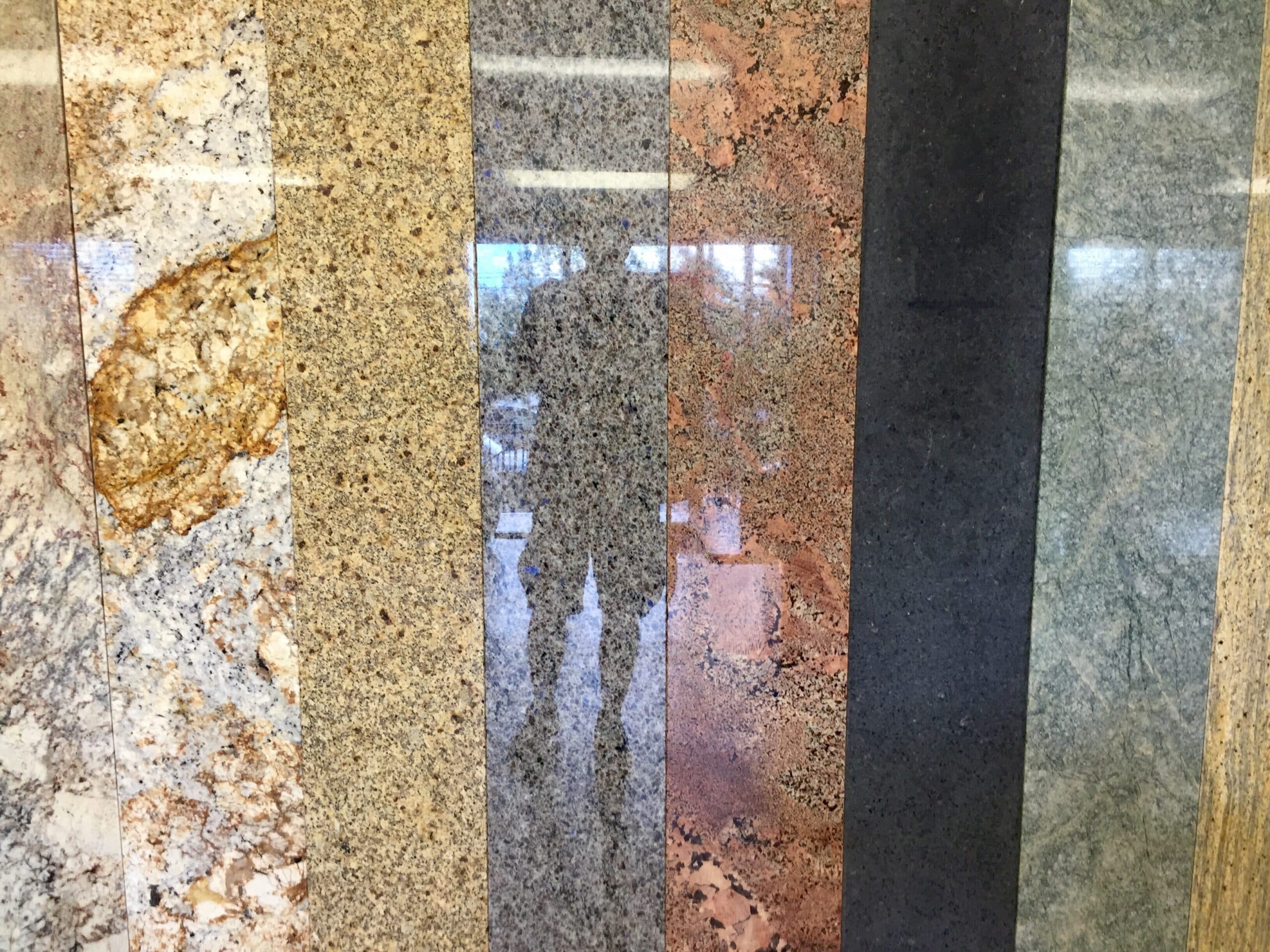
Granite countertops in Tampa get sold two different ways. One is a four inch sample chip in a showroom binder. The other is the actual slab standing on a rack at a stone yard, seven feet tall and full of movement the chip never showed you.
Homeowners who buy from the chip are the ones who get surprised on install day. That gap between what was pictured and what arrives causes most of the disappointment we see with granite countertops.
Here is what to check before you sign off on anything.
Your sample chip is not your countertop
Granite comes out of the ground, so no two slabs match. Blocks get cut into slabs sequentially, then sold in bundles.
Slabs from the same bundle look similar because they were adjacent inside the block. Slabs from a different block of the same named granite can look like a different stone entirely.
That means the name on the sample tells you very little. Two homeowners can both order Colonial White and end up with kitchens that share almost nothing visually.
So go see the slab. Most stone yards serving the Tampa Bay area will let you walk the racks with your fabricator or designer, and reputable ones will tag and hold the specific slabs you select.
Take a photo of the tag number. If your fabricator handles selection for you, ask for photos of the exact slabs reserved under your name, not stock images of the color.
While you are there, ask how many slabs your kitchen needs and whether they all come from the same bundle. A large island paired with perimeter runs often takes three slabs, and mixing bundles across one kitchen is a visible mistake.
What to inspect before you approve granite countertops in Tampa
Look at the slab in daylight, not under yard fluorescents. Color reads differently outside, and Tampa kitchens get a lot of natural light.
Fissures versus cracks
Run your hand across the face of the slab. Fissures are natural separations that form along crystal boundaries as the stone cools, and they are normal in granite.
On a polished slab, a fissure sits flush and your fingernail passes over it. A crack catches.
Cracks are structural. A fabricator should reject that slab, not work around it.
Pitting
Small pits between mineral crystals are also normal, particularly in coarse-grained granites with heavy quartz content.
They are part of the stone, not a defect. You just want to know they are there before the countertop is in your kitchen rather than after.
The back of the slab
Many granites receive a resin treatment at the quarry, applied when blocks are cut into slabs, which fills micro porosity and strengthens the surface. According to the Natural Stone Institute, this treatment is now common across the industry.
A fiberglass mesh backing tells you the slab is fragile and needs careful handling. That matters most on large island spans.
Thickness
Three-centimeter slabs carry themselves and give you a full edge profile.
Two-centimeter slabs usually require a plywood substrate and a laminated edge to look thicker, which adds labor and creates a glue line. Neither is wrong, but the quote should say which one you are getting.
Where the movement lands matters as much as the slab you pick
This is the part homeowners rarely think about, and it separates a good granite installation from an average one.
Every slab has direction. Veining runs one way, color concentrates in certain areas, and your kitchen has fixed points that interrupt it.
Sink cutouts, cooktop openings, and the ends of an island all cut into the pattern. A skilled fabricator lays out your template digitally over photographs of your actual slabs so you can see where the best movement lands before a saw touches anything.
Seam placement follows the same logic. Seams are unavoidable on most kitchens, but where they sit is a decision.
Behind a sink is common and forgiving. Across the middle of an island where everyone eats breakfast is not.
At Cabinet IQ of Tampa, templating and seam placement are handled as part of countertop installation rather than left to chance on install day. Ask any fabricator you are considering whether you get to approve the layout. If the answer is vague, keep looking.
Finish changes how granite behaves day to day
Polished is the standard finish and the one most people picture. It reflects light, deepens color, and resists staining slightly better because the surface is tighter.
It also shows water spots, which is worth knowing given how hard the water runs across much of the Tampa Bay area.
Honed granite has a matte surface with a softer look. On lighter stones it works beautifully, though on dark granites it tends to show fingerprints and cooking oils more readily.
Leathered finishes have a subtle texture that hides both. They have become a popular request on darker granite countertops in Tampa for exactly that reason, and they hold up well in kitchens that get heavy daily use.
Do granite countertops in Tampa need sealing every year?
Homeowners are often told they do. That advice is broader than the facts support.
The Natural Stone Institute notes that most granite countertops do not require sealing at all, though many still benefit from it as added protection against moisture.
Test yours instead of guessing. Pour a small amount of water on the surface and wait about thirty minutes.
If a dark ring appears, the stone is absorbing, and a penetrating sealer is worth applying. If the water sits there, you are fine.
What about radon?
This question comes up often enough that it deserves a direct answer.
The EPA states that it is extremely unlikely radiation from granite countertops would raise annual doses above normal background levels, and that radon entering from soil beneath a home is a far larger risk than radon from granite.
Their recommendation is to test your home for radon regardless of what your countertops are made of.
Coordinating granite with the rest of your kitchen
A slab you love in isolation can fight the room it goes into.
Granite carries more visual activity than most engineered surfaces, so busy stone generally wants calmer cabinetry. Quiet stone gives you room to be bolder with door styles and finishes.
Cabinet door samples brought to the stone yard settle most of that question in a few minutes. Comparing them against the actual slab under the same light removes the guesswork that photos leave behind.
Pairing decisions like these get made early in our kitchen design process, before selections are locked and slabs are cut.
Budget shapes the conversation too. Countertops sit in the middle of most kitchen remodeling costs in Tampa, and slab selection lands early in the kitchen remodel timeline, usually well before demolition starts.
See your slab before you commit
Granite is a twenty-year decision made in an afternoon at a stone yard. Going in with a plan changes the result more than any other single factor.
Cabinet IQ of Tampa guides homeowners through slab selection, layout approval, and installation, so what you approved is what gets installed.
Book your free consultation for granite countertops in Tampa with Cabinet IQ today.