Lazy Susan & Corner Cabinet Solutions Compared
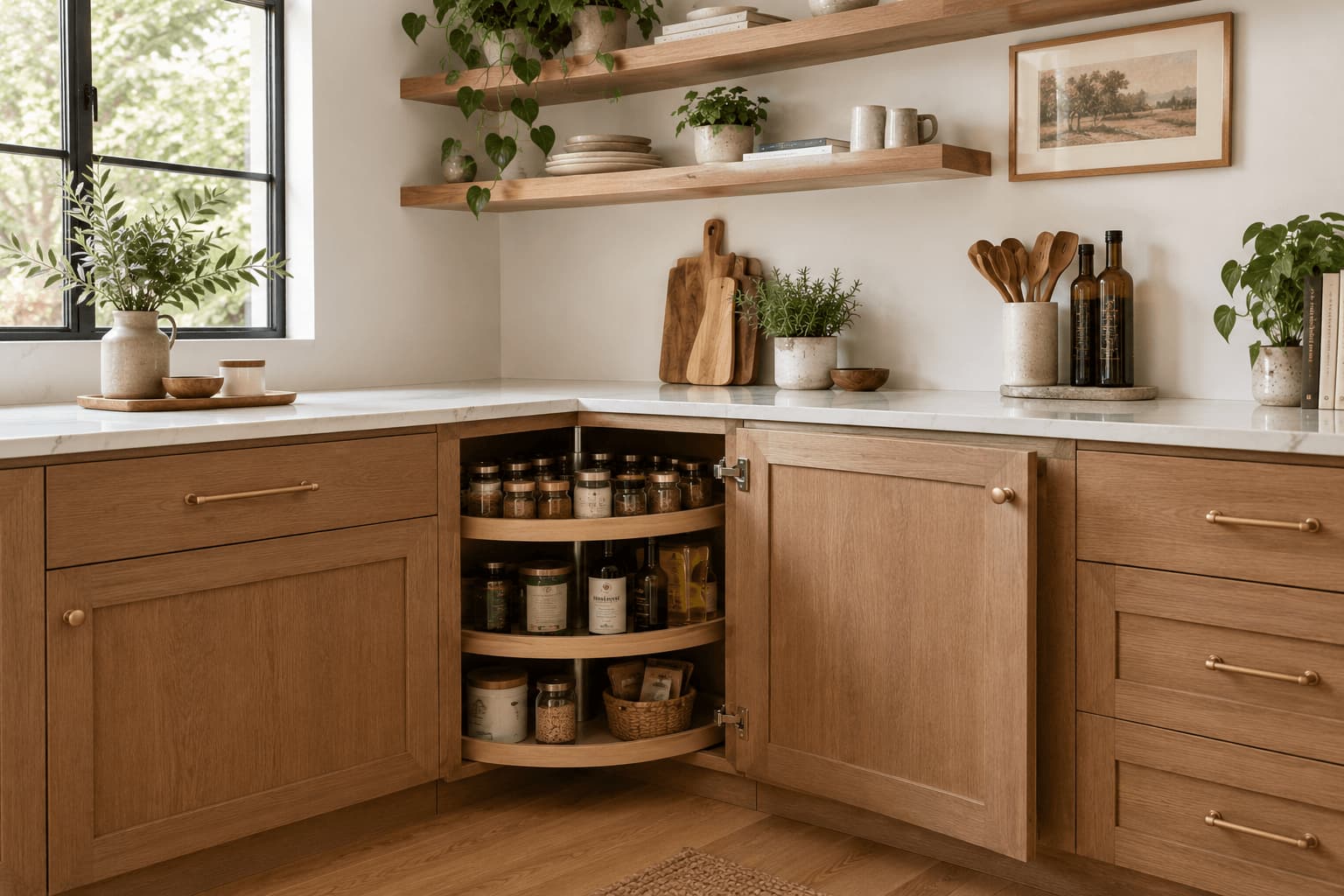
Open a corner base cabinet in most kitchens, and you’ll find one of two things: a spinning Lazy Susan you half-trust, or a dark, awkward void where things go to disappear. Either way, that corner is quietly deciding how easy your kitchen is to live with, how often you kneel on the floor, how many extra steps you take, and how much storage you actually get from the room you paid for.
If you’re planning a remodel or trying to rescue an existing layout, choosing the right corner cabinet organizer means looking beyond the hardware itself. A Lazy Susan, blind-corner pull-out shelves, or swing-out system can each make sense depending on the cabinet configuration, what you plan to store, how much access you want, and what fits your budget.
The differences become clearer once you compare how each option works, how much usable storage it creates, and how comfortable it is to use day to day.
Quick answer: A Lazy Susan works well when you want simple, affordable rotating storage in a corner cabinet designed for one. A blind-corner organizer can be a better fit when accessibility, heavier cookware, or deep storage matters more. The right blind corner cabinet solution depends on your cabinet type, door opening, storage needs, budget, and how much reaching you want to avoid.
What’s Really Happening Inside Your Blind Corner Cabinet?
A blind corner cabinet is storage space you paid for but can’t comfortably reach without help from hardware.
In typical L-shaped and U-shaped kitchens, it’s the base cabinet where one run continues behind another, leaving a deep area that’s hard to see and harder to use. Without specialized hardware, that space can become “dead” volume: technically there, practically unusable.
That’s usually where you end up storing:
- Small appliances you rarely use
- Overflow pantry items “for later”
- Pots, pans, and lids that don’t fit anywhere else
Over time, the cabinet can become a catchall you rarely want to dig through. Items disappear into the back, duplicates get bought, and finding one lid or appliance can mean extra bending, reaching, and frustration.
That is where the right corner solution for your cabinet interiors can make a practical difference: not by creating more square footage, but by making more of the space you already have accessible.
Lazy Susan: Classic Rotating Solution Explained
A Lazy Susan is the classic answer to awkward corners in kitchen cabinetry: rotating shelves that spin inside the corner cabinet, allowing easy access to items at the back. In kitchen corner cabinets, you’ll commonly see:
- Full-round trays in a diagonal-front corner cabinet
- Pie-cut trays attached to the bifold cabinet doors that swing open with the shelf
- Half-moon or kidney shape tray in a blind corner that pivots out and then rotates
These corner organizers are at their best when you store lots of smaller items, such as spices, condiments, cans, baking supplies, or small containers.
By simply spinning the tray, you can view everything without digging. The mechanism is straightforward and familiar, which is why many older corner storage systems still utilize some version of it. With decent quality hardware, a Lazy Susan can offer a valuable upgrade from fixed shelves, making kitchen access more efficient.
Why Do They Call It a Lazy Susan?
The origins of the term "Lazy Susan" are somewhat mysterious, with various theories about its name.
- One popular story credits Thomas Jefferson with popularizing a similar device after he returned from France, inspired by the "dumbwaiter" style or 'serving in the French style.' He supposedly named it after his daughter, Susan.
- Another hypothesis suggests that the term emerged in early 20th-century America, where the name 'Susan' was a generic name for servants, and as homes invested in labor-saving devices, the rotating tray became the 'Lazy Susan.' Its role in facilitating self-service was especially significant when domestic help declined.
- Elizabeth Howell's 1891 patent for "certain new and useful Improvements in Self-Waiting Tables" resembles modern Lazy Susans, which by the mid-20th century became staples in Chinese-American food culture, allowing you to swiftly grab soy sauce with your dim sum.
So, while its origins remain partially unclear, the functional elegance of the Lazy Susan continues to make it a favored kitchen product.
What Are the Trade-Offs of a Lazy Susan?
The trade-offs of using a Lazy Susan arise from its round design and mechanics.
Round or pie-shaped trays can leave unused wedges of pantry space within a square cabinet.
Heavy or tall items might cause wobbling or dragging on the trays, and overloaded center posts may sag or rub, depending on the bearing and installation. Precise door and hinge positioning is crucial; otherwise, the tray may catch or scrape.
When Does a Lazy Susan Make Sense—and When Doesn’t It?
Assessing a Lazy Susan’s fit involves examining your specific corner cabinet and usage needs. Consider cabinet configuration and daily experience over familiarity with hardware designs.
Where a Lazy Susan makes sense:
- You have a true corner cabinet designed for a Lazy Susan (diagonal or L-shaped front).
- You primarily store smaller, mid-weight kitchen products or pantry items.
- Your budget requires an upgrade from fixed shelves without high costs.
- You’re comfortable with occasionally leaning into the cabinet for access.
Where it’s less ideal:
- You have a blind corner cabinet hiding behind another run.
- You need to store heavy cookware or small appliances.
- Maximizing every storage inch is a higher priority than familiar hardware.
- You wish to avoid managing posts, bearings, and precise door hinges over time.
In such cases, other storage solutions like pull-out shelves or systems like Kesseböhmer LeMans may be better. Lazy Susans remain a simple, practical solution when matched correctly to the right cabinet configuration.

How Do Blind Corner Pull-Outs, Magic Corners, and LeMans Systems Work?
Modern blind corner organizers are crafted to solve the “dark void” issue often faced with corner cabinets by pulling or swinging trays into the doorway, granting you easy access to nearly every item stored. Unlike a rotating tray or lazy susan, these systems move the storage space directly toward you, making them particularly beneficial in deep kitchen corners.
The main categories of these corner storage systems include:
- Linked blind-corner pull-outs (“Magic Corner” style): These organizers feature front trays attached to the cabinet door. When you open the door and pull, the front trays glide out, and the rear trays slide seamlessly over into the opening, providing access to almost every inch without delving into the cabinet box.
- LeMans-style swing-out trays: Typically used for pots, pans, and mixing bowls, these shaped, kidney-like trays rest on pivot arms. They smoothly swing out of the corner in a graceful, curved path, then retreat back into the cabinet when you’re finished. The Kesseböhmer LeMans and Richelieu LeMans II are renowned products in this category, expanding your kitchen cabinetry options.
- Simpler sliding trays: Designed with shallow shelves or baskets on full-extension slides, these trays pull out towards you. Though they may not utilize every inch of the space within blind corner cabinets, they considerably enhance the storage capacity compared to fixed shelves and are usually simple to retrofit within existing cabinetry.
Because these trays are carefully contoured to the cabinet’s interior, they utilize more of the deep corner volume than a round tray would and present stored items front-and-center instead of hidden within.
However, the added complexity of these systems includes more moving parts, precise installation, and often a higher cost in hardware resources.
In summary, for genuine blind corner cabinets, these storage solutions can transform what feels like an inaccessible abyss into a practical part of your kitchen experience, making them a top consideration for those comparing corner cabinet solutions.
How Do Corner Cabinet Ergonomics Differ Between Lazy Susans and Blind Corner Organizers?
When comparing corner cabinet ergonomics, the distinctions between Lazy Susans and blind corner organizers become evident. Ergonomics, specifically, minimizing bending and twisting to access cabinet items, can significantly enhance your kitchen experience.
Lazy Susan Differences:
A Lazy Susan, a rotating tray or turntable, reduces some reaching compared with fixed shelves, but still requires leaning into the cabinet to grab items, especially those positioned at the back edge. While suitable for lightweight items like spices and condiments, accessing heavier cookware from a crouched position can be awkward. Additionally, storing many items, like plates or even china dishes, on a Lazy Susan may leave less storage space and make it harder to access each item efficiently.
Blind Corner Organizer Advantages:
Blind corner organizers, such as pull-out shelves or LeMans trays from brands like Kesseböhmer LeMans and Richelieu LeMans II, bring storage to you, improving ease of access. These corner organizers allow trays to slide or swing into the doorway, letting you stand upright, see all items easily, and lift cookware from an extended surface. This design can be particularly advantageous for heavier items, as it mitigates the awkwardness of reaching into a rotating shelf.
Considerations for Users:
- Height and Accessibility: Kids and shorter adults might find it difficult to reach deeply into a Lazy Susan. Conversely, swing-out trays that extend towards them are easier to access.
- Elderly Users: Older family members may prefer pull-outs or swing-out corner storage systems in blind corner cabinets, as they reduce deep-reaching requirements.
- Noise and Smooth Operation: Higher-quality pull-out systems with properly adjusted tracks and bearing slides provide a solid, quiet experience when accessing stored items.
- Stored Items' Nature: Consider the type of items to be stored. While a Lazy Susan suits pantry items like spices, blind corner pull-outs may better accommodate large cookware and countertop appliances.
If bending and twisting pose challenges, particularly around inaccessible cabinet areas like those near sinks or in low cabinets, opting for pull-out or swing-out organizers might offer a worthwhile investment in comfort and functionality, ensuring you have the best solution catered to your kitchen cabinetry needs.

Lazy Susans vs Blind Corner Organizers
When deciding between Lazy Susans and blind corner organizers, consider how each contributes to overall kitchen functionality, space-saving, and ease of use. The differences in cabinet organization products become apparent not only on paper but also in how they function day-to-day in your kitchen cabinetry setup.
Storage Capacity
A full round tray or pie-cut tray Lazy Susan inside a corner cabinet introduces a rotating tray that allows for easy access to condiments and spices, but those triangular spaces remain unused, reducing potential pantry space. In contrast, a blind corner organizer like the Kesseböhmer LeMans or Richelieu LeMans II maximizes storage space efficiently. These products embrace the cabinet’s awkward footprint, converting it into organized storage solutions suitable for larger pots and kitchen appliances.
Durability
Lazy Susans boast simplicity with features like a turntable resting on bearings, ensuring smooth rotation. Mid to high-quality units with solid construction can provide a durable experience, though they depend heavily on proper weight distribution and installation instructions for longevity. Conversely, the durability of pull-out pantry shelves or systems like the LeMans trays substantially hinges on quality hardware resources, such as a dual-slide rail system, which should be chosen based on the nature and weight of stored items in your corner storage systems.
Maintenance
Maintenance varies significantly. Lazy Susan shelves, with their rotating trays, may collect spills and crumbs, necessitating regular wiping. On the other hand, pull-out shelves reveal more areas for cleaning yet allow for simpler maintenance due to their full-extension design. Easy access to slides and tray bottoms makes vacuuming or wiping down straightforward, ultimately enhancing your organizational experience by keeping your kitchen tidy without the dread typically associated with deep corner cabinet cleaning.
Quick Comparison
Here’s a quick side-by-side snapshot of how Lazy Susans and modern blind-corner organizers compare.
| Feature | Lazy Susan | Blind Corner Organizers |
| Ergonomics | Reduces reaching but still requires some leaning into the cabinet | Brings trays into the doorway; reduces deep reaching |
| Storage capacity | Loses corner wedges in a square box | Shaped trays can make more of the deep corner accessible |
| Heavy cookware | Better suited to lighter items unless the system is rated appropriately | Can work well for heavy pots and appliances when hardware is sized and rated correctly |
| Retrofit friendliness | Often easier to add into existing corner cabinets | More sensitive to exact cabinet size and door opening |
| Upfront cost | Typically lower hardware cost | Higher hardware and installation cost per cabinet |
| Long-term feel and maintenance | Simple mechanics; quality varies by hardware | Smooth when quality and installation are right; more parts to maintain |
If you prize simplicity above all, a well-made Lazy Susan can be more than enough. If you want to make more of a true blind corner accessible and prefer storage that moves toward you, modern pull-out and swing-out systems are worth considering.
How Cost and Installation Differ Between Lazy Susans and Blind Corner Organizers
Cost and installation complexity are where Lazy Susans and modern blind-corner organizers really start to diverge. Two cabinets that look similar on a floor plan can land in very different budget ranges once you choose the hardware that lives inside them.
You can expect Lazy Susan kits to be on the more affordable side, especially in plastic or wire. They’re widely available, and some are designed to retrofit into an existing corner cabinet.
By contrast, blind-corner pull-outs and LeMans systems usually cost more per cabinet.
Higher-quality hardware, soft-close mechanisms, and shaped trays can push them into the “investment” category. Installation is also more precise: clearances, handedness (left/right blind), door opening, and cabinet construction all matter if you want smooth motion and useful extension.
If you aren’t changing the cabinet boxes, door opening size, interior width, plumbing runs, and face-frame vs. frameless construction, it can narrow your options quickly. In some older blind corners, a half-moon Lazy Susan or simpler pull-out tray may be the more practical upgrade without rebuilding cabinetry.
In a remodel or new build, you have the chance to design the cabinet box and door setup around the hardware you want, which makes premium pull-outs far easier to plan and install correctly.
At Cabinet IQ, those decisions are considered throughout the design and installation process, so cabinet dimensions, clearances, storage needs, and hardware requirements can be addressed early and your budget goes into solutions that will actually fit and work with the finished design.
What to Measure Before Choosing a Corner Cabinet Organizer
Before ordering any blind corner cabinet organizer, measure the cabinet itself rather than relying only on the nominal cabinet size.
At minimum, confirm:
- Door opening width: The usable opening that the organizer must pass through
- Interior cabinet width: The available space inside the cabinet box
- Interior depth: The distance available for trays, slides, and pivoting hardware
- Interior height: Especially important for multi-level systems or taller stored items
- Left- or right-hand orientation: Some organizers are designed for a specific blind-corner direction
- Door and hinge clearance: Make sure hinges and doors won’t interfere with moving trays
- Nearby appliance or wall clearance: Swing-out systems need enough room outside the cabinet to move freely
Manufacturer requirements vary, so treat the organizer’s installation specifications, not a generic measurement, as the final authority before ordering.
This is one of the easiest places for an otherwise good corner cabinet solution to go wrong. A system can be well-made and still perform poorly if the opening, cabinet dimensions, or orientation don’t match the hardware.
That’s one reason Cabinet IQ approaches storage hardware as part of the cabinet design itself: the best organizer is only a good solution when the cabinet dimensions, clearances, and the way you use the kitchen all work together.
From an Awkward Corner to a Smarter Kitchen With Cabinet IQ
A Lazy Susan or corner cabinet organizer may seem like a small decision compared with cabinets, countertops, appliances, and finishes. But details like these have a lasting effect on how your kitchen works every day.
The right solution isn’t simply the one with the most impressive hardware, but the one that fits your space, what you need to store, and how you actually use your kitchen.
That’s where thoughtful kitchen remodeling design makes a difference. Cabinet IQ considers storage, cabinetry, clearances, layout, and the way your household uses the space as part of the bigger picture. Instead of treating an awkward corner as an afterthought, it can be planned alongside the rest of the kitchen so the finished space feels intentional from one cabinet to the next.
If you’re planning a remodel, Cabinet IQ can help you turn those needs into a kitchen designed around how you live.
Ready to make better use of every corner? Schedule a design consultation or showroom visit with Cabinet IQ to explore the right storage and layout options for your kitchen.