Plywood vs Particle Board Cabinets: Which Is Actually Better?
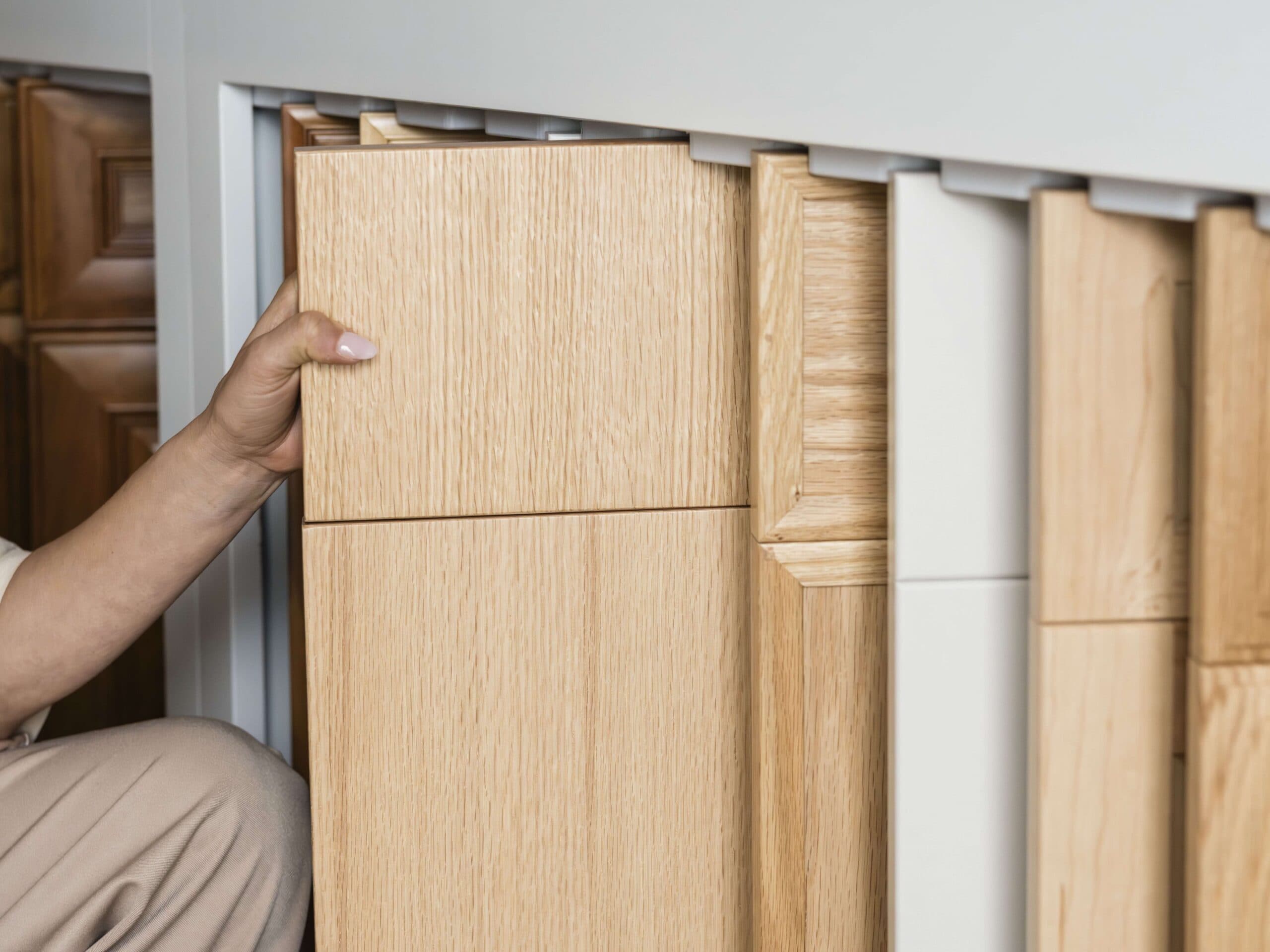
You’re reviewing your kitchen remodel quote when you notice the different price ranges depending on the material, and “plywood box construction" is one of them.
Then the questions start: Does the material for cabinet construction even matter? Is plywood worth it? Is particle board good enough? Are you paying for better durability, or just a more expensive cabinet spec?
Those are fair questions. Cabinet box building material will affect how your kitchen handles daily use, moisture, storage weight, and long-term wear, but the right choice depends on your layout, budget, and how you plan to use the kitchen.
The key is to stop thinking in marketing labels and start thinking in structure.
By the time you finish this guide, you’ll understand what’s really inside plywood and particle board cabinet boxes, how each behaves under stress and spills, where plywood shows its worth, and how a smart material mix can protect both your kitchen and your budget.
Why Cabinet Box Construction Matters More Than Most Homeowners Realize
Most kitchens don’t age faster than others, only because of door style or paint color.
They fail because the boxes behind the pretty cabinet doors were never strong or square enough to begin with.
Understanding the cabinet construction and materials, such as plywood or particleboard, can make a significant difference in the long-term value of your kitchen renovation.
Signs Your Box Construction is The Problem
The box is the backbone of your kitchen. When its sides and back flex or drift out of square, everything you touch every day slowly moves with it.
In everyday use, early warning signs often show up as:
- Doors that won’t stay closed or keep drifting out of alignment
- Drawers that scrape, feel rough halfway out, or no longer glide smoothly
- Gaps around doors and drawers that are tight on one side and wide on the other
What might look like an issue with the cabinet or drawer hardware is really the box behind them losing its shape and durability.
The Two Crucial Qualities
Moisture resistance is crucial, as moisture accelerates all of this. A slow drip under the sink or years of steam near a dishwasher can cause even solid wood to suffer moisture damage. Low-grade engineered wood, such as particle board or MDF, will easily swell at corners and cutouts under those conditions.
Screw-holding strength is another silent culprit: when hinges and drawer slides are anchored into a weaker core, every slam works those screws a little looser until they finally strip out.
What are Plywood and Particle Board?
While both plywood and particle board, of furniture board, are types of engineered wood, their construction methods create two very different types of building materials.
What are Plywood Cabinet Boxes Made of?
Plywood cabinet boxes are made from thin sheets of wood veneer glued into layers, with the natural wood grain of each layer running at right angles to the next.
That cross-laminated structure gives cabinet-grade plywood its strength, stiffness, and ability to stay flatter as humidity changes.
While not as strong as solid wood, plywood cabinet boxes usually still provide stronger sides, sturdier backs, better screw holding, and shelves that are less likely to sag under heavy dishes, small appliances, or pantry goods.
What are Particle Board Cabinet Boxes Made of?
Particle board cabinet boxes are made from small wood particles bonded with resin and pressed into dense, uniform panels.
In many cabinet lines, the core is covered with a laminate or melamine finish, giving the cabinet interior a smooth, bright, wipeable surface.
High-density or furniture-grade particle board, also known as furniture board or fiberboard, is much stronger than low-end chipboard, especially when it is used with proper panel thickness, strong backs, and quality joinery.
The tradeoff is that particle board cabinet boxes still need better protection at exposed edges, screw holes, and plumbing cutouts because water can cause the core to swell.
The Thicker, The Better
Both materials come in multiple thicknesses, often 1/2, 5/8, or 3/4 inch.
A thick, high-density furniture board core can outperform a thin budget plywood cabinet panel in some locations, so the real comparison is not just plywood vs particle board.
You want to know the cabinet core material, panel thickness, density, back construction, edge treatment, and how the box is joined.
How to Tell What Your Current Cabinets Are Made Of
A quick flashlight check inside a sink base, pantry, or unfinished shelf edge will usually tell you what you’re dealing with.
- Plywood reveals stacked veneer layers on cut edges.
- Particle board looks like compressed wood chips or sawdust.
You don’t have to guess; you just need to look in the right places to assess the internal strength of your cabinet boxes.
If you are comparing cabinet lines, start with the full cabinet box specification, not just the door style or finish. You can also review Cabinet IQ’s cabinet options to see how construction, materials, and design choices work together in a finished kitchen.
Plywood vs Particle Board Cabinets: Quick Comparison
Before you get deep into cabinet specs, it helps to see the tradeoffs side by side. Plywood and particle board can both work in kitchen cabinets, but they behave differently under weight, moisture, and daily use. This quick comparison shows where each material tends to perform best.
| Factor | Plywood cabinets | Particle board cabinets |
| Strength and stiffness | Usually stronger and more rigid, especially in long spans and heavy-load areas | Can perform well when panels are thick, dense, and properly supported |
| Moisture resistance | More forgiving if minor moisture reaches the core, though still not waterproof | More likely to swell at exposed edges, screw holes, and plumbing cutouts if water gets inside |
| Screw holding | Typically holds hinge, slide, and fastener screws better over time | Depends heavily on density, fastener type, and edge quality |
| Shelf sagging | Better resistance in wide shelves and heavy-use storage | More vulnerable in long spans unless the panel is thick and well supported |
| Cost | Usually budget-friendly | The most budget-friendly |
| Best use | Sink bases, plumbing cabinets, wide drawer bases, pantries, and long-term kitchens | Dry uppers, light-use storage, rental refreshes, flips, and budget-sensitive projects |
| Bottom line | Best when durability and moisture margin matter most | Best when cost control matters and the cabinet is used in lower-risk areas |
The short answer: plywood cabinets are usually better for wet, heavy-use, and long-term kitchens.
Most medium-density fiberboards (MDF) or particle board cabinets can still make sense in dry, lighter-use areas when the panels are dense, the edges are protected, and the cabinet box is built well.

Plywood vs Particle Board Cabinets: Strength And Spills
If you care about how cabinets feel ten or fifteen years from now, you need to know how these cores behave under weight and moisture, not just how they look on day one.
Strength and Stiffness
In strength and stiffness, cabinet-grade plywood generally has the advantage, especially in long spans, heavy-use bases, and cabinets that need to resist racking over time.
- Plywood cabinets: The cross-laminated veneer structure resists bending, so long shelves are less likely to sag under stacks of plates, small appliances, or pantry goods. That same structure helps boxes resist racking when they’re loaded, moved, or fastened to less-than-perfect walls.
- Particle board: However, a strong furniture board can still do good work when it’s used intelligently. Thicker panels, shorter spans, and strong backs make a big difference. Many high-end frameless European cabinet manufacturers rely on dense engineered cores and perform beautifully because the design is tuned to the material: proper thickness, solid joinery, and robust backs.
Spill and Water Resistance
Moisture is where the gap often becomes most noticeable. If water gets past the finish and into the core:
- Particle board tends to swell more at edges, cutouts, and screw holes. Swelling in those spots can become permanent, leaving soft or crumbly areas.
- Plywood can still be damaged if it stays wet, but it is usually more forgiving than lower-grade particle board when moisture exposure is limited.
Repairability
Repairability follows the same pattern.
- Plywood cabinets: A loose hinge screw in plywood often tightens up again or accepts a simple repair like a glued dowel.
- Particle board: The same failure in a weak furniture board edge can force you to move the hinge, use specialty fasteners, or replace the panel altogether.
For most real kitchens, cabinet-grade plywood buys you margin where the box has to handle weight, movement, and moisture.
High-density furniture board can still work well in dry, lower-load cabinets when the cabinet construction quality is strong.
Is Plywood Cabinet Box Construction Worth the Price?
Whether plywood is “worth it” depends on how long you plan to live with the kitchen and what a failure would actually cost you in money, hassle, and disruption.
Better for Long-Term value
If you’re building a long-term kitchen and you cook often, use heavy cookware, or have kids and pets, it makes sense to treat cabinet boxes as a 15- to 20-year decision.
Paying more now to avoid sagging shelves, swollen sink bases, or door and drawer issues years down the road is easier to justify over that time frame.
Harder Choice for Only Short-Term Use
For a short-term flip where you’ll be out in a year or two, the equation changes. You’re focused on clean inspections, great photos, and the first few years of buyer use. In that case, high-density furniture board cores with solid joinery can be a rational choice, especially if the neighborhood norm is similar construction.
A Combined, Layered Design Can Be Best
Long-term investors sit in the middle. They want to avoid tenant damage and moisture failures without overspending.
In those projects, a smart pattern is:
- Plywood in sink bases, plumbing cabinets, and long, heavily loaded boxes
- High-quality engineered cores in dry uppers and light-use storage
- Clear specs so future repairs and replacements are predictable
A designer who understands cabinet materials and your hold period can help you decide where plywood box construction is valuable insurance and where it may be optional.
At Cabinet IQ, that comparison is part of the design conversation, so your cabinet package matches your layout, lifestyle, budget, and expected hold period.

The Cabinet Components That Matter Just as Much as the Box Material
Cabinet quality is not determined by core material alone. Even strong plywood cabinet boxes can disappoint if the joinery, backs, hardware, or edge sealing are weak.
Joinery Keeping it All Together
Joinery comes first. Boxes built with full backs, glued and screwed joints, and proper dadoes or locking connections stay square far better than boxes held together with staples or tiny fasteners.
When you hear terms like “full back,” “glued-and-screwed dado joints,” or “3/4-inch cabinet-grade sides,” you’re usually looking at a stronger box, regardless of the core.
Panels and Rails
Back panels and hanging rails are the next quiet heroes. A full-thickness back that’s firmly tied into the sides spreads load across the panel and into the wall fasteners. Thin, stapled-on backs or undersized rails concentrate stress and can let wall cabinets tilt or pull away over time.
Hardware
Hardware is the daily interface between you and the box. Quality hinges and drawer slides feel smoother, but they also distribute forces against the cabinet face frames more evenly and tolerate small movements in the substrate. That reduces the risk of screws tearing out of weaker cores and gives you more adjustment years down the line.
Finishes
Finishes and edge treatments protect the cabinet core. Well-sealed edges, quality paint or interior finish options, and careful sealing around sink bases, dishwasher panels, and plumbing cutouts all buy time if moisture reaches the cabinet box.
Where Each Cabinet Material Makes the Most Sense
The best plywood vs particle board cabinets decision usually happens by zone, not by choosing one material for every box.
Some parts of the kitchen need more moisture resistance, screw holding, and structural stiffness. Others simply need a clean, durable interior at a sensible price.
- Wet and plumbing areas: Sink bases, dishwasher-adjacent cabinets, and boxes with plumbing cutouts are the highest-risk locations. Cabinet-grade plywood is usually the safer choice here because it gives the box more margin if a small leak, drip, or spill goes unnoticed.
- Heavy-use storage: Wide drawer bases, tall pantry cabinets, appliance surrounds, and cabinets loaded with cookware need stiffness and strong fastening points. Plywood performs well in these locations, but thick, high-density furniture board cores can also work when the cabinet backs, hanging rails, drawer slides, and joinery are built for the load.
- Dry, lighter-use cabinets: Upper cabinets, display cabinets, and light-duty storage areas are often good candidates for furniture-grade particle board with a durable melamine or laminate interior. In these locations, you can often save money without giving up the cabinet performance that matters most.
The point is not to make particle board sound bad or plywood sound perfect. The point is to match the cabinet core material to the risk level of each part of the kitchen.
How Cabinet Box Material Affects Resale, Rentals, and Remodel ROI
Cabinet box material also matters because not every kitchen has the same financial goal. A homeowner planning to stay for 15 years may value plywood box construction differently than an investor preparing a rental or a seller getting a home ready for the market. Plywood typically lasts over 20 years in kitchens and retains 84%-100% of its bending strength after 10 years, which is part of why it holds up so well across such different use cases. Plywood is typically 30–50% more expensive than particle board, so the right choice often depends on how long you plan to stay and what kind of return you're expecting from the investment.
Best Option for Resale
For resale, buyers may not ask about cabinet core material by name, but they do notice how the cabinet feels.
Doors that align cleanly, drawers that glide smoothly, and shelves that feel solid all support the impression of a better remodel. In higher-end homes, plywood cabinet boxes can also help the specification match buyer expectations. Plywood is lighter relative to its structural strength, making it easier to install, which can also help keep installation timelines and labor costs more predictable during a resale-focused remodel.
When Rentals Are the Goal
For rentals, durability and repairability matter more than luxury. Plywood is preferred in high-moisture areas like kitchens and bathrooms due to its resilience, so plywood in sink bases, plumbing cabinets, and heavily used lower cabinets can reduce the risk of swollen panels, stripped screws, and service calls. Plywood cabinets can often outperform poorly constructed particle board cabinets in these high-wear spots, and plywood provides better repair options than particle board in case of damage, which matters a great deal for landlords managing turnover between tenants. In dry upper cabinets or lighter-use areas, high-density particle board can still help control cost, since particle board requires only a veneer or laminate finish to be visually acceptable in areas that don't see much daily stress.
Budget Remodels
For budget-sensitive remodels, the smartest ROI often comes from upgrading the cabinets most likely to fail, not from paying for the same material everywhere. Particleboard typically lasts 5–7 years before degrading, so it makes sense to reserve it for lower-risk cabinets and put plywood where moisture and heavy use are more likely. Hybrid cabinet designs can utilize plywood for structural components and particle board for surfaces, giving budget-conscious homeowners a practical middle ground between cost and durability.
What to Check Before You Approve Your Cabinet Quote
Once you understand how plywood and particle board behave, the right questions become much easier to ask.
Before you sign, ask for clear answers to these questions:
- What is the cabinet core material for each box type: plywood, particle board, MDF, or a hybrid package?
- How thick are the cabinet sides, backs, shelves, and hanging rails?
- Are the backs full-height and structurally fastened, or thin panels attached after assembly?
- How are the boxes joined: dado joints, glued-and-screwed construction, staples, cams, or another method?
- How are sink bases, plumbing cutouts, dishwasher-adjacent panels, and exposed edges sealed?
- What hinges, drawer slides, and fasteners are used?
If a supplier cannot answer those questions directly, treat that as a signal. Strong cabinet specifications read like structure, not vague marketing copy.
This is also where a guided design session pays for itself.
Sitting down with a designer who understands construction, not just color and style, lets you line up what you expect from your kitchen with how the boxes are actually built.
Cabinet IQ's kitchen design process is built around helping homeowners understand those decisions before installation begins, including measurements, product selection, design review, and quality checks.
When You Want Cabinets That Stay Solid For The Long Haul
At the end of the day, plywood vs particle board cabinets is not a question of "good" versus "bad." It is a question of cabinet box construction, moisture risk, storage weight, installation quality, and how long you expect the kitchen to serve you.
If you're tired of guessing from line items and buzzwords, this is the point where a structured design process helps.
Cabinet IQ can help you compare solid wood, plywood, particle board, and hybrid cabinet packages side by side. You leave knowing exactly what's behind your cabinet doors and what that means ten or fifteen years from now, so when you finally sign that cabinet order, you're doing it with clear eyes and a long-term plan for how your kitchen will live with you.
Schedule a Cabinet IQ design consultation.